Hi Fi Writer - Dictionary of Home Entertainment
Home Page |
About Me |
Home Entertainment |
Home Entertainment Blog |
Politics |
Australian Libertarian Society Blog |
Disclosures
A Dictionary of Home Entertainment Terms
Last updated 15 February 2013
This is a practical Dictionary of Home Entertainment terms. The idea is to allow you to find not just the raw meaning of a term, but what it means in real life.
You may find it convenient to link to specific definitions contained here from your own Web site. There is a link to each specific term immediately after the term (right click on 'link' and select 'Copy Shortcut' from the context menu).
If there are other useful terms you would like to see defined or explained, or you wish to dispute a definition or correct some error, email me at scdawson at hifi-writer.com.
This dictionary has nearly 400 entries.
1
A
B
C
D
E
F
G
H
I
J
K
L
M
N
O
P
Q
R
S
T
U
V
W
X
Y
Z
-
 1080i link
- A video display standard, where there are 1,080 visible lines delivered in
interlaced format. It is one of the standards permitted in Australia to be regarded as
HDTV.
-
1/4" jack link
- See 6.25mm jack.
-
16:9 link
- The
aspect ratio of a widescreen TV, in which the height of the screen is nine sixteenths of its width. Sometimes expressed as 1.78:1 (~16/9).
-
16:9 enhanced link
- A picture format used for widescreen movies on DVD. See anamorphic for a full explanation.
-
1.85:1 link
- One of the most common
aspect ratios of cinema films, and consequently of DVDs. This leaves substantial black bands at the top on bottom of the display on a standard
4:3 TV, but matches quite nicely with the 1.78:1 aspect ratio of a
16:9
widescreen TV. On such a TV, even the expected thin black bands at the top and bottom of the display are often missing, due to the TV's
overscan.
-
1/8" plug link
- See 3.5mm plug.
-
2.35:1 link
- One of the most common
aspect ratios of cinema films, and consequently of DVDs. This leaves very wide black bands at the top on bottom of the display on a standard
4:3 TV, and significant black bands even on the 1.78:1 aspect ratio of a
16:9
widescreen TV.
-
2.5-way loudspeakers link
- A
loudspeaker which divides the incoming signal into three different
frequency bands for distribution to
drivers, but in a different way to
three-way speakers. It sends high frequencies to the
tweeter in the usual way, and low frequencies to one or more
woofers. But it sends the
midrange frequencies and the low frequencies to an additional bass/midrange driver in the same way as is done in a
two-way speaker. In other words, all but one of the large drivers handle
bass only, while the last handles both bass and midrange.
-
3:2 pulldown link
- The method used in the
NTSC video system for converting the 24
frames per second of film to the 30 frames per second the video system requires. See
here for more.
-
3.5mm plug link
- Or 1/8" plug. Often used on portable headphones and playback equipment. They tend to offer relatively unreliable connections due to the very small contact area within the socket.
-
4:3 link
- The
aspect ratio of a standard TV, in which the height of the screen is three quarters of its width.
-
480i link
- A video display standard, where there are 480 visible lines delivered in
interlaced format. When delivered in
analogue format, it is identical to
NTSC.
-
480p link
- A video display standard, where there are 480 visible lines delivered in
progressive format.
-
5.1 link
- The number of channels of audio in a modern movie. The '5' refers to full range channels: moving clockwise, left front, centre front, right front, right surround and left surround. In
Dolby Digital,
DTS and
MPEG 5.1 formats, each of these five channels is capable of a
frequency response covering the full audible range (up to 20,000 hertz). The '0.1' refers to the
LFE channel, which is not full range but designed to cover up to 120 hertz, thus the decimal point.
-
576i link
- A video display standard, where there are 576 visible lines delivered in
interlaced format. When delivered in
analogue format, it is identical to
PAL and is Australia's picture delivery standard for
SDTV.
-
576p link
- A video display standard, where there are 576 visible lines delivered in
progressive format. It is one of the standards permitted in Australia to be regarded as
HDTV, although in reality it offers no more resolution than
576i.
-
6.1 link
- An enhancement of the
5.1 channel surround system, versions of this appear in both
Dolby Digital and
DTS. The Dolby Digital version is called
Dolby Digital EX 6.1 while the DTS version appears as either
DTS ES 6.1 Discrete or
DTS ES 6.1 Matrix. The additional channel is intended to sit at the rear of the room (although two
speakers are recommended, even though the same signal is provided to both). This provides a greater localisation of sounds from the centre rear. This is a very useful enhancement in cinemas where much of the audience are sitting off-centre, but in normal rooms with a small number of viewers, it is much less important.
-
6.25mm jack link
- Or 1/4" jack. Familiar from the larger type of headphone jacks (or plugs), these are widely used in professional audio as well. They come in both
mono (two conductors) and
stereo (three conductors) versions. The latter type are often termed in pro-audio as
TRS jacks, and in which application they are often wired for
balanced mono operation.
-
720p link
- A video display standard, where there are 720 visible lines delivered in
progressive format. It is one of the standards permitted in Australia to be regarded as
HDTV.
-
 A/V link
- Audio/Visual, as in A/V connections. Most modern TVs have separate sockets for the
composite video signal (that's the yellow one) and sound (black or white, or red and white if stereo).
-
AC-3 link
- AC-3 is the encoding scheme used in
Dolby Digital, the name by which it is now more commonly known.
-
AC link
- Alternating Current. An electric current that reverses direction regularly. More generally, AC is also used to describe voltage sources in which the polarity of the signal reverses regularly. Power distribution networks use AC because it is relatively easy and cheap to alter the voltage (using
transformers) yielding considerable economies for long distance power transmission. All the counties in the world use, it seems, either a 50 or 60
hertz frequency for their power systems. Europe, Australia and India use 50 hertz. The Americas and Japan use 60 hertz. Compare with
DC.
-
Academy aspect ratio link
- 1.37:1, the
aspect ratio for movies used almost exclusively up to the early 1950s.
-
Academy sound link
- Fairly soon after the introduction of talkies in the late 1920s, the movie industry settled on using an
analogue
optical soundtrack on the edge of the film to carry the sound. This was read by the projector and converted to an electrical audio signal. This was a very noisy medium, so in the absence of advanced noise reduction technology such as
Dolby A (the cinema equivalent of, and precursor to, the Dolby B and C noise reduction systems on
compact cassettes), the situation was eased by sharply cutting the
treble response (at around
5kHz). The bass was also cut, which accounts for the characteristic pinched sound of old movies. The recommended system of
frequency response tailoring was called 'Academy Sound'.
-
Acoustic suspension link
- A design for the
enclosure of a
loudspeaker. With acoustic suspension speakers the enclosure is sealed so that it is air tight, which causes the air within to become a very active part of the
woofer's suspension. This raises the
resonant frequency of the
driver and lowers its
compliance. Acoustic suspension speakers tend to be less
efficient than
bass reflex designs, and begin fading away their bass at a higher
frequency. But the rate at which the bass output reduces tends to be less than an equivalent bass reflex speaker, so they frequently produce greater
bass extension. Also called
infinite baffle.
-
Active loudspeaker link
- A
loudspeaker with built-in
amplification for all the drivers. Some speakers have an amplifier built-in for
bass only, but these are not regarded as active. Most loudspeakers are
passive, not active.
-
Active subwoofer link
- A
subwoofer with built-in amplification. Most subwoofers are
active, not
passive.
-
ADC link
- Analogue to Digital Converter. A component, circuit or device that converts an
analogue signal to a digital one, usually to some form of
PCM. Compare DAC which does the reverse.
-
AES/EBU link
- Audio Engineering Society/European Broadcasting Union. A
digital audio communication standard most commonly seen in professional audio applications. Electrically it is only subtly different to the consumer-oriented
S/PDIF standard, the main variation being a different method of handling the
clocking signal, and it generally being carried by
balanced connections. Nevertheless implementations are seen that seem to be fully compatible with unbalanced S/PDIF.
-
AM link
- Amplitude Modulation. A method of impressing a signal onto a
sine wave for its transmission or storage. A constant
frequency sine wave has its
amplitude increased or decreased from moment to moment to correspond with the signal. The sine wave, called a carrier, must be of considerably high frequency than any component of the signal. AM radio is an application of this technique. Very simple AM receivers (consisting of little other than a crystal and a coil) can be implemented very easily to receive these signals, although of course more sophisticated circuits can produce higher quality results.
-
Amp link
- Short for ampere, or for
amplifier. In the former sense, the amp is a unit of electrical
current. Amps equal volts divided by resistance (or impedance) in ohms.
-
Amplifier link
- A component or module of a component that increases the
amplitude of an electrical signal. Voltage amplifiers and
current amplifiers are optimised to provide amplification for specific purposes. See also
power amplifiers and preamplifiers.
-
Amplitude link
- The level of an electrical signal, usually measured in volts.
-
Analogue link
- As in not
digital. An analogue signal in an electrical facsimile of the item being represented. For example, when playing a stereo DVD, the analogue audio outputs of a DVD player trace an electrical curve that is identical, other than in sheer power, to the electrical curve that the
amplifier will deliver to the
speakers and this, in turn, is identical to the pattern of sound waves the speaker will create, except for distortions that creep into the system. An analogue signal can have any value within set limit, while a digital signal is constrained to a set of discrete values.
-
Anamorphic link
- Also known as '16:9 enhanced' or 'widescreen enhanced'. This means stretching a picture out of shape, making the images tall and skinny. Many widescreen movies have been filmed on standard
Academy aspect ratio cameras and film stock. This can be done either by wasting a lot of film between each
frame, or making use of the full frame by using an anamorphic lens to horizontally squeeze the picture together. If a single frame is looked at, the characters will be as mentioned. When the film is shown, a reverse form of the anamorphic lens widens the picture again so that everything appears as it should. On DVDs an anamorphic widescreen picture is encoded to use all the vertical lines of
resolution available (576 for
PAL and 480 for
NTSC). When played back on a
widescreen TV it is horizontally stretched so that the picture contents are shaped normally, but with the benefit of DVD's full resolution. If played back on a 4:3 TV (that does not have a widescreen mode), the DVD player's set up menu must be told so that the DVD player can convert the anamorphic picture to a letterboxed picture for the TV.
More.
-
ANSI lumens link
- American National Standards Institute lumens. A measure of brightness for projectors under standards set by this body. This specifies an average brightness produced on a screen of known reflectivity using a particular test image, or images. A specification war is underway with each projector claiming a higher and higher ANSI lumens rating. The amount of brightness required for a good job from a projector requires three things to be taken into account, in order of increasing importance: the reflectivity of the projection surface, the size of the projected image, and the amount of ambient light in the room. High output projectors (> 1,000 ANSI lumens) are important for making presentations, class room work and the like. But for home theatre use, look for something lower, preferably under 700. It will generally give you a longer lamp life and darker black areas, which are more important for delivering a good quality image. If the projector has an 'economy mode', try using this. If it doesn't throw out the colour balance too much, it may well deliver a better home theatre image.
-
Anti-skating link
- A device on a
turntable's
tonearm to counteract
skating. This sometimes consists of an adjustable spring-loaded device near the tonearm's pivot, but is better implemented as a weight on a string (since the torque applied by this arrangement remains constant throughout the range of travel).
-
Aperture grille link
- A part of a
CRT TV tube. This is a barrier within the tube, placed between the electron guns at the narrow end and the phosphor screen at the wide end. It consists of a series of vertical wires or fine slats. The geometric arrangement permits the electrons emitted for each colour gun to activate only its matching colour phosphors. This alternative to the
shadow mask was developed by Sony and marketed under the name 'Trinitron'.
-
Aspect ratio link
- The width of the screen as a ratio of its height. A standard TV screen is four units wide to three high, so is described as
4:3 or 1.33:1. A
widescreen TV has an aspect ratio of
16:9 or about 1.78:1. Widescreen cinema movies are typically
1.85:1 or 2.35:1.
-
ATRAC link
- A system for compressing
digital audio using
perceptual encoding techniques. This was developed by Sony to allow the full contents of a CD to fit onto a
Minidisc, which offers considerably less storage space. In recent years a new version, called ATRAC3, has been introduced which permits greater levels of
compression than the original version. This permits ATRAC-based solid state players. The bit rates used by ATRAC3 are 132 and 66
kb/s. The ATRAC compression system also forms the basis of Sony's cinema sound system
SDDS.
-
Audiophile link
- A person who places, or would like to place if circumstances permitted, a high priority on having an audio system that performs very highly. They have generally trained themselves to be very discerning about the sound of audio systems. Some audiophiles stray into a purely
subjective realm.
-
A-weighting link
- A system of adjusting
signal to noise ratio measurements to take into account the differing sensitivity of the human ear to different
frequencies. Thus an A-weighted signal to noise ratio more accurately reflects how a system's noise performance will be perceived than an unweighted measure.
-
 Baffle link
- A plate surrounding a
driver in a
loudspeaker. The lower the
frequency of the sound produced by the vibrating cone of a driver, the more apt it is to simply cause air to rush from one side of the cone to the other, rather than produce the compression waves that constitute sound. By adding a baffle around the driver, this increases the length of the path that air must travel, lowering the frequency at which this
destructive interference takes place. In most loudspeakers, the
enclosure forms a baffle. In the case of
infinite baffle enclosures, the enclosure is sealed (thus 'infinite') while with
bass reflex speakers a
port is carefully tuned to allow energy from the back of the cone to supplement that from the front at selected bass frequencies. In regular talk, the baffle is the front panel of the loudspeaker.
-
Balanced link
- An electrical circuit in which both the signal leads (positive and negative, active and neutral or whatever) carry equal but inverse signals produced by the source. These require three conductors: two for the signal plus a separate one for the
shielding. Balanced connections are fairly rare in consumer electronics, although they are provided in some high-end equipment. Well-designed balanced circuits provide excellent rejection of electrical interference generated in connecting wires. Balanced connections frequently use
XLR plugs and sockets.
-
Band pass filter link
- An electrical circuit that only permits signals between two particular
frequencies to pass through. An example is section of a
crossover network that allows only the middle frequencies to be delivered to the
midrange driver.
Compare
low pass filter and
high pass filter.
-
Bandwidth link
- Either the range of
frequencies which a component can deal with competently (often specified as the range across which the attenuation is no more than
3dB), or the frequency range required to carry a signal. For example, the bandwidth required for a
composite video signal is somewhat more than
5MHz.
-
Bass link
- Low
frequency sounds, typically below around 150
hertz, although the dividing line between bass and midrange is one of opinion. The human ear is less sensitive to bass than to midrange.
-
Bass extension link
- An imprecise term concerning how low in
frequency a loudspeaker or
subwoofer can still operate to produce usable output. A typical bookshelf-sized speaker may manage a bass extension of 80
hertz (say, at -10dB), a good floorstanding speaker may manage 30 or 40 hertz, an inexpensive subwoofer 40 hertz, a middling one 25 to 30 hertz, an expensive one 16 hertz.
-
Bass management link
- A facility in
home theatre receivers that permits some of the speakers in a
5.1 channel system to be specified as 'small' rather than 'large'. 'Large' speakers receive the entire signal for their respective channel, but 'small' speakers have the
bass stripped off and sent elsewhere. If a subwoofer is attached, this bass goes to it, otherwise it goes to the front main speakers (you will notice that most systems will not permit you to select 'small' for the front stereo pair if you have the subwoofer set to 'off'). Some home theatre receivers permit you to choose the
crossover frequency for bass management, but many use a standard value of 80
hertz.
-
Bass reflex link
- A design for the
enclosure of a
loudspeaker. With bass reflex speakers the enclosure has a
port that permits air to flow between the interior and exterior of the cabinet. The port is a hole, usually backed by a tube. The dimensions of the port are carefully calculated so that it permits
bass at a selected
frequency to be produced from the interior of the enclosure (driven by the back of the
woofer's cone). This arrangement permits a bass reflex speaker to generally achieve greater efficiency than an
acoustic suspension speaker, and it extends the depth at which bass may be produced without significant attenuation. However for frequencies below the band produced by the port, the output drops off quite rapidly.
-
Belt link
- Sometimes the loop of material that is used to transmit rotational energy from motor to record platter on a
turntable. Here, though, I am referring to a set of extreme audio system
tweaks popularised in the 1980s and beyond by
Peter Belt in the United Kingdom. These tweaks, for the most part, have no measurable effect on the sound produced by the system and there is no rational reason why they would affect, let alone improve, the sound of the system. They include such ideas as placing an extra sheet of paper in all books within the listening room, to ensure that there are an odd number of leaves in each book, placing a sheet of paper 'twixt the floor and just one leg of your listening chair and, more recently,
freezing and then defrosting your CDs. Try not to laugh. Some
subjective reviewers have, over the years, sworn by these measures.
-
Beta link
- Or Betamax. The first widely-used consumer-level
video recording system on the market. Developed by Sony in the late 1970s, it eventually lost out to the rival
VHS system, which came to market about a year later, primarily because of shorter playing and recording times.
-
Bipole link
- A
loudspeaker designed to offer well-dispersed sound by firing its high
frequencies, and in some models its full frequency range, in two opposing directions. Unlike
dipole speakers, the sound is in
phase from all the drivers.
-
Bit link
- The smallest unit of digital information. A single bit can carry just one of two values: 0 or 1. There are eight bits in a
byte, 1,024 bytes in a
kilobyte, 1,024 kilobytes in a
megabyte and 1,024 megabytes in a gigabyte. Sometimes, though, the traditional 1,000 is used rather than 1,024, leading to confusion. A bit should generally be abbreviated as lower-case 'b' (compared to 'B' for byte). Thus 128kb/s means 128 kilobits per second, whereas 128kB means 128 kilobytes.
-
Bit depth link
- The size of the number that records each
digital sample.
Since the system is digital, the number relates to powers of two. The compact disc uses a bit depth of 16, which allows 65,536 different levels to be used to track the
analogue source signal. DVDs usually also use 16, but may also use 20 bits (which gives over a million levels) or 24 bits (which gives more than 16.7 million levels). The greater the bit depth, the lower the
harmonic distortion and quantization noise, and the more storage space required for the signal.
-
Bit rate link
- The number of digital bits a system transfers per second. In general, the higher the bit rate, the higher the quality of the signal. In every case, the higher the bit rate, the more data space required. With audio bit rates are measured in the hundreds of kilobits per second
(kb/s). With DVD video, they are measured in megabits per second
(mb/s).
-
Bitstream link
- The digital audio output of a DVD player, when switched to outputting the DVD's native digital audio format. Most DVD players can be switched to output a
Dolby Digital bitstream, or convert the digital output to
PCM.
-
Blu-ray link
- A high capacity development of the DVD which uses higher
frequency (blue) rather than red light frequencies for reading the disc. The combination of shorter wavelengths and other enhancements bumps up the maximum capacity from
8.5GB for a dual layer DVD to around 27GB, allowing the storage of high definition video.
-
Bob link
- One of several strategies used in deinterlacing video. Bobbing is where each field is displayed all by itself in sequence. The intermediate lines are created by interpolating from the lines above and below it. This has the effect of reducing the vertical resolution at any instant of time by half (but it doesn't seem as bad as this, thanks to the interpolation), but smoothing pans because the two fields are displayed one fiftieth of a second apart. This is useful for video sourced material, in which the two interlaced
fields constituting the full video
frame were actually captured at slightly different times from each other, causing a combed effect on vertical lines. Compare
weave.
-
Bonus group link
- A
Group on a
DVD Audio to which access can be gained only through entering a four digit numeric password. Rarely, if ever, used for any actual content. See
here for more.
-
Byte link
- Eight
bits. A byte can represent numbers between 0 and 255, or when interpreted as signed integers, between -128 and +127.
-
 Cantilever link
- The thin rod within a turntable's cartridge that transmits the movement of the
stylus in response to a record's groove to the interior components of the cartridge that generate the electrical signal.
-
Carrier link
- A
sine wave which may be modulated by a signal to form an
AM signal. The frequency of the carrier must be significantly higher than that of the modulating signal. In practice, the carrier is usually a radio frequency sine wave, and so is two orders of magnitude higher in frequency than the signal.
-
Cartridge link
- The device that converts the movements of a
stylus in the grooves of an
LP to electrical signals. The cartridge is a small, light-weight device, secured to the end of a
turntable's tonearm by means of two screws mounted 12.5mm apart. The movements of the stylus are transmitted through a cantilever to some form of electrical generating device. The two main types of cartridge are
ceramic and magnetic. The latter is further subdivided into moving magnet and moving coil types.
-
CAV link
- Constant Angular Velocity – as opposed to
CLV. A method of spinning a disc or disk carrying a signal. CAV means that the rate of spin remains unchanged regardless of where the reading device is on the surface. An
LP is an example (which is part of the reason why the outer tracks tend to sound better than the inner ones). While
CDs are designed to be operated at a CLV, fast CD-ROM drives actually run them with a CAV.
-
CBR link
- Constant bit rate – as opposed to
variable bit rate. The signal (video or audio) is digitally encoded so that a fixed amount of data flows each second. This has the advantage of making the space requirements for the signal easy to calculate.
DTS and
Dolby Digital are both CBR systems, as are the earlier versions of
MPEG audio and video
compression. Most
MP3 files are CBR encoded, although the format does support VBR as well.
-
CD link
- Compact Disc -- This is the familiar 120mm optical disc. It carries a digital
PCM representation of a two channel analogue signal, along with error correction information. The analogue signal is
sampled at 44,100 hertz and uses a
bit depth of 16.
-
CD emphasis link
- When the
compact disc was first developed, the designers implemented a rather surprising element in its specification. This was a pre-emphasis, de-emphasis cycle. In brief, this permits the
treble in the source signal to be boosted before the CD is mastered (pre-emphasis), recording this fact by a special
bit in the package around each segment of audio data, and cut again by the CD player (de-emphasis). When cut, it also had the advantage of reducing any noise due to the recording medium. But, in practice, there is no such noise, so initially it can be hard to see the purpose of this. Then when you consider that for most music the amplitude of the signal reduces as the
frequency increases at around
6dB per octave, you can see that the amplitude of the higher frequency components would be very low and, consequently, subject to increased
quantization noise. Boosting the higher frequencies significantly reduces this noise accordingly. The
frequency response of the signal is pre-emphasised by boosting the signal from 50µs (microseconds -- which is what engineers used to specify frequency in some contexts) or 3,183
hertz, and levels out at 15µs, or 10,610 hertz, with a maximum boost of 10.45dB. CDs that actually use this are rather rare.
-
Ceramic cartridge link
- A cartridge that produces an electrical signal through a piezoelectric effect. Such cartridges are rarely used in high fidelity applications because they require a relatively high tracking weight (usually upwards of 10 grams), have a low
compliance and produce an uneven frequency response. However they do have the advantage of producing a rather higher output voltage than
magnetic cartridges, and their frequency response characteristics approximate the
RIAA equalization curve, allowing simpler circuitry to be used with the signal.
-
Chapter link
- The divisions within a
Title on a
DVD Video. Navigation is most easily achieved by using the forward and reverse 'skip' keys of the DVD player's remote control.
-
Chroma link
- The colour component of a TV picture signal. This comprises of two colour difference signals (the CR and CB) matrixed together. While these two signals are carried separately on a DVD, if the signal is delivered to the TV via an
S-Video cable, they are matrixed together, slighty reducing colour clarity.
-
Cinch plug link
- Another name, used by companies that presumably don't like to use the opposition's brand name in their own literature, for
RCA plug.
-
Class A link
- A power amplifier in which a sufficient
DC bias voltage is applied to the power transistors so that the output signal always operates entirely in the positive or negative part of the cycle, entirely avoiding
crossover distortion. This makes them quite wasteful of power since even at idle a considerable voltage is being generated. The DC bias is filtered out before being fed to the speakers.
-
Class A/B link
- A power amplifier in which a certain amount of
DC bias voltage is applied to the power transistors so that, at low power outputs, the output signal operates entirely in the positive or negative part of the cycle, avoiding
crossover distortion. Thus, at low outputs, a Class A/B amplifier operates in
Class A mode. At higher outputs the signal does cross over the zero point, effectively entering Class B territory. This design is a compromise between the efficiency of Class B amplifiers (in which there is no DC bias) and the elimination of crossover distortion in Class A designs. The DC bias is filtered out before being fed to the speakers.
-
Cliff effect link
- Where the degradation of a signal's reception does not gradually increase with a reduction in signal quality or strength, but maintains full quality until some threshold, at which point the signal collapses into incoherence.
Analogue transmissions tend to degrade gradually.
Digital transmissions in modern systems (with
error correction built in) tend to maintain full quality, but then cut out completely at the threshold.
-
Clipping link
-
 When the
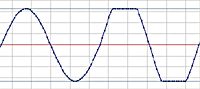
amplitude of a signal reaches some limit determined by the equipment in use, it hits a ceiling (and floor) beyond which it cannot proceed. So the top and bottom of the wave is simply lopped off. The more it attempts to exceed the limit, the more that's chopped off, and the closer to a
square wave the formerly rounded wave begins to look. This causes it to generate lots of harmonics, and so it sounds very distorted. The graphic to the right shows a sine wave at the left, and then the same sine wave amplified by just three decibels, to the right. This relatively minor clipping generates a third harmonic of 14%, a fifth harmonic of 3%, a seventh of 1.8% and so on. Truly awful sounding. Clipping is often caused by turning up an
amplifier too loud so that its power limits are exceeded.
When the
amplitude of a signal reaches some limit determined by the equipment in use, it hits a ceiling (and floor) beyond which it cannot proceed. So the top and bottom of the wave is simply lopped off. The more it attempts to exceed the limit, the more that's chopped off, and the closer to a
square wave the formerly rounded wave begins to look. This causes it to generate lots of harmonics, and so it sounds very distorted. The graphic to the right shows a sine wave at the left, and then the same sine wave amplified by just three decibels, to the right. This relatively minor clipping generates a third harmonic of 14%, a fifth harmonic of 3%, a seventh of 1.8% and so on. Truly awful sounding. Clipping is often caused by turning up an
amplifier too loud so that its power limits are exceeded.
-
Clocking signal link
- A signal used to synchronise items of equipment which are communicating
digital audio or video signals to each other. The lack of a suitable clocking signal would allow their timing to drift apart from each other since their internal clocking signals would generally not be identical, so digital
samples would be lost.
-
Cloth ears link
- A purported characteristic of a person, the possession of which is alleged to account for his or her inability to notice differences in the sound quality produced by different pieces of equipment. Those so accused, assuming they have taken care to listen carefully to the demonstration, should forthrightly reject the allegation.
-
CLV link
- Constant Linear Velocity – as opposed to
CAV. A method of spinning a disc or disk carrying a signal. CLV means that the rate of spin varies in order to maintain a constant velocity of the track at the point where the reading device is on the surface. A
CD playing back in an audio CD player is an example of this, because the CD player runs at about 500rpm at the start of the CD (where the inner grooves are being read), gradually reducing speed to about 200rpm as the track nears the outer edge.
-
Coaxial Digital link
- The digital audio output signal of a DVD player in an electrical format, rather than
optical. The data format accords with the
S/PDIF specification.
-
Codec link
- Compression/Decompression. A system which compresses a signal in some way for storage or transportation and then decompresses it at the point of delivery. Examples are
MPEG,
Dolby Digital and
DTS. These systems use a codec to reduce the amount of data in the signal. Other forms of codec, particularly in the days of
analogue audio systems, compressed and then decompressed the
dynamic range of the signal, not to reduce the size of the signal but to reduce noise levels. One consumer system was called 'dbx'.
-
Colouration link
- An unwanted alteration in the character of audio. Significant colouration of sound can make instruments and voices sound unrealistic. It may be caused by
harmonic distortion, vibrations of component parts (for example, the panels of
an inadequately braced
loudspeaker enclosure) or, most commonly, through an uneven
frequency response.
-
Colour difference link
- These are two of the three components of a colour video signal. One is the Red colour difference signal, called variously Y-R or CR while the other is the Blue colour difference signal (Y-B or CB). They are created from the original
RGB signal by creating a
luminance signal (Y) and then subtracting this from the red and blue respectively (thus the name, colour 'difference'). When combined with the luminance signal the original three RGB signals can be recreated with very little degradation. The two colour difference signals and the luminance signal are, together, known as
component video.
-
Compact cassette link
- A neatly packaged magnetic tape recording and playback system for audio introduced in the 1960s. This uses a narrow plastic tape with four tracks running at a speed of 47.6mm/s (1 7/8 inches per second), contained in a sturdy plastic enclosure. In consumer equipment, only two of the tracks are accessible at any one time, providing
stereo recording and playback. The tape is turned over (or an auto-reverse transport moves the recording and playback heads sideways) to access the other two tracks. Some semi-professional four track recording systems allow all four tracks to be recorded and played back at once, or even separately to permit multi-track recording. All cassette decks capable of recording (some are playback-only) have at least two heads: a record/playback head and an erase head. Some better decks include three heads, with separate record and playback heads to allow close-to real-time monitoring of the recorded material directly from the tape, and allowing the heads to be optimised for their different functions. While initially very low in fidelity, in the early 1970s tremendous advances were made in tape formulations, first with Chromium Dioxide magnetic materials and then later with 'Metal' tapes, which extended the high
frequency response and improved their saturation characteristics. The addition of
Dolby B noise reduction (and later Dolby C) reduced the inherent problem of high noise levels due to the low tape speed.
-
Compander link
- Compressor/Expander. A noise-reduction system that works by compressing the
dynamic range of the audio before recording, and expanding it again by an equivalent amount during playback. An example of this was the dbx system.
-
Compliance link
- The degree of 'springiness' in a mechanical system. For example, the cone of a
loudspeaker driver with a soft suspension which can move to and fro relatively easily is more compliant than one with a stiff suspension. The
stylus of turntable cartridge with a high compliance tends to follow the
excursions of the groove more easily than a that of a cartridge with low compliance.
-
Component video link
- Three components of a video signal that, together, constitute the full signal. The three components are
luminance (Y), red
colour difference (CR) and blue colour difference (CB). These can be wrapped into each other to various degrees to form
S-Video signals or composite video signals. On DVD the video signal is carried in component video form. The best way to deliver the DVD's picture to the TV is therefore via either component video connections (in which case, the TV reconstitutes the original RGB signal required for its
CRT), or RGB (in this case, the DVD reconstitutes the RGB signal). For more on the quality differences between component video, S-Video and composite video, go
here.
-
Composite video link
- This is the way that the three
component video signals are wrapped together to form a single signal, suitable for TV broadcast or carrying on a single two-conductor cable. The two
colour difference signals are first matrixed together to form the
chroma signal, and then the
luminance signal is matrixed into this to create a single composite video signal. This process results in some cross interference between the chroma and luminance portions of the signal, reducing picture quality. For more on the quality differences between component video,
S-Video and composite video, go
here.
-
Compression link
- Reduction. Air is compressed by squeezing it into a smaller space.
Digital signals are compression by reducing the amount of data space required to hold them. Some digital data compresses readily, due to easily identifiable redundancy within the data. So, for example, a text document typically has a lot of space characters and 'e' characters, so other ways of expressing these can be found.
Digital audio and video signal tend not to carry a lot of redundancy, so systems that compress these highly rely on eliminating some of the data and are consequently called
lossy compression systems.
-
Compression driver link
- A kind of
loudspeaker driver. Rather than using a speaker cone to directly vibrate the air in a room, a compression driver has a throat in front of the moving part that causes a relatively small amount of air to compress and rarify rapidly in response to the movement of that part. This, in turn, drives the vibration of the air in front of it into the room, through some form of
horn. Most compression drivers use
piezo effects for the initial vibration, although some use more or less conventional cones. Compression drivers offer significantly higher
efficiency than conventional drivers, allowing high output levels for a given input power, but can tend to reduce the
dynamic range of the input signal and
colour the sound.
-
Compression ratio link
- The extent to which a signal (particularly digital signals) is compressed, expressed as a ratio of the uncompressed size to the compressed size of the data.
MP3, for example, with a bit rate of 128kb/s has a compression ratio of about 11:1.
-
Contrast ratio link
- The ratio between the darkest blacks (ie. the
pixels in the area are fully shut off) and the brightest whites (pixels fully on) capable of being produced on-screen by a projector or other display device. For quality home entertainment work, this is a far more important than the
ANSI lumens rating. LCD projectors typically have a specified contrast ratio of between 500:1 and 1,100:1.
DLP projectors tend to start around 1,000:1 and the newer models can reach as high as 3,500:1.
CRT projectors, noted for being the best at producing black blacks, are up around 15,000:1.
-
Constructive interference link
- Where two signals, added together, act in sympathy with each other to boost the signal level. For example,
bass from a subwoofer may, at certain
frequencies, bounce from a nearby wall and that reflected signal may interfere with bass still coming directly from the subwoofer to effectively increase the output at that frequency. But it is also likely, at other frequencies, to result in
destructive interference.
-
Crossover distortion link
- A small discontinuity (or, at least, nonlinearity) in a signal when a transistor-based
amplifier circuit switches from positive to negative operation. This is addressed by
Class A and Class A/B designs. Sometimes called 'zero cross distortion'.
-
Crossover frequency link
- The
frequency at which a signal is handed from one component to another. This applies in
crossover networks and
bass management systems.
-
Crossover network link
- The set of components in a
loudspeaker that divides up the incoming signal, sending the
bass to the
woofer, the treble to the
tweeter and, sometimes, the middle
frequencies to a
midrange driver. The crossover network uses resisters, capacitors and inductors (coils) to divide up the signal. Some high end systems use active crossover networks. In such cases, the division is made before the signal is amplified, so a separate
amplifier is required for each driver.
-
Crosstalk link
- Where a signal (particularly audio) leaks from one channel to another. Thus a voice may be intended to be entirely in the left channel of a
stereo recording, but some portion of it appears in the right, dragging the apparent position of the voice somewhat towards the centre of the
sound stage. Normally specified by the inverse of crosstalk:
separation.
-
CRT link
- Cathode Ray Tube: the guts of a traditional tube TV. Electron beams are fired from the narrow end at the back of the set towards the much bigger screen end. There they strike multi-coloured phosphor patches or stripes and emit the coloured light that you see. The appropriate signals are matched to the appropriate red, green and blue phosphors by means of either a
shadow mask or an aperture grille.
-
Current link
- The quantity of electrical charge moving through a circuit over a given time. The unit for current is
amps or amperes.
-
 DAC link
- Digital to Analogue Converter. A component, circuit or device that converts
a digital signal to
an analogue one. Compare ADC which does the reverse.
-
Damping factor link
- A specification for
power amplifiers which suggests the degree of control that the amplifier exercises over a connected
loudspeaker. It is the ratio of the
nominal impedance of the speaker (and is typically quoted for eight
ohms) to the internal
impedance of the output stage of the amplifier. A high internal impedance for the amplifier means that its
frequency response will vary with real-world speakers since their impedance varies across their
frequency range. It also means that the
driver, which wants to do its own thing under the influence of air, its suspension and so forth, rather than what the signal is telling it to do, will face a relatively high impedance to the voltage it is generating back into the amplifier. Consequently it will be freer to do its own thing, rather than what the amplifier is telling it to do. However the damping factor quoted for amplifiers does not take into account the impedance of the wiring between amplifier and loudspeakers, nor the impedance of the speakers' own
voice coils. Consequently there is only a modest performance gain between a damping factor of, say, 60 and one of 600.
-
DAT link
-
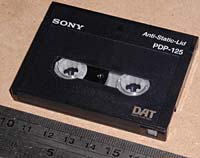 Digital Audio Tape. A compact tape developed in the late 1980s by Sony which stores audio in
PCM format. The tapes look very similar to the MiniDV tapes used in digital video cameras, but are somewhat larger, measuring 71mm wide by 53mm deep and 10mm thick. The reading part of the tape is protected by the casing. In order to pack sufficient capacity on, the tape is read using a helical scan head in the same way as a
VCR. The default format for DAT is a 48
kHz
sampling frequency and 16
bits of
resolution, but they can also be switched to 44.1kHz.
Digital Audio Tape. A compact tape developed in the late 1980s by Sony which stores audio in
PCM format. The tapes look very similar to the MiniDV tapes used in digital video cameras, but are somewhat larger, measuring 71mm wide by 53mm deep and 10mm thick. The reading part of the tape is protected by the casing. In order to pack sufficient capacity on, the tape is read using a helical scan head in the same way as a
VCR. The default format for DAT is a 48
kHz
sampling frequency and 16
bits of
resolution, but they can also be switched to 44.1kHz.
-
dB link
- Decibel. (See decibel.)
-
dBFS link
- Decibel - Full Scale. The level of a signal, measured in
decibels, with reference to the maximum possible level of the signal. With
digital audio the maximum recording level is 0dBFS, so all measurements of the signal are negative values.
-
dBSPL link
- Decibel - Sound Pressure Level. A measure of sound intensity. This is a logarithmic measure. To increase the sound level by three
decibels, it is necessary to double the power output. A 10dB increase in sound level roughly equates with a perceived doubling of volume level. A figure of around 120-130dB is normally considered to be the threshold of pain. dB is sometimes loosely used as a synonym.
-
DC link
- Direct Current. An electric current that retains its level and direction, at least in the short term. More generally, DC is also used to describe voltage sources that deliver this kind of current. DC is generally used at low voltages within electronic equipment. Batteries deliver DC. Compare with
AC.
-
DCC link
- Digital compact cassette. An attempted replacement for the
compact cassette introduced by Philips in the late 1980s, early 1990s. This recorded audio in
digital format, but used a
lossy compression system. It failed to make headway since Sony's
Minidisc had the advantage of direct access and, more recently, the recordable CD provides convenient and cheap recording with higher quality.
-
Deinterlace link
- The conversion of an interlaced video signal to a progressive video signal. Two common systems are
weaving and bobbing.
-
Decibel link
- Abbreviation dB. A logarithmic measure of ratio. To determine the decibel relationship of, for example, two
voltages you use the formula dB=20*log(V1/V2). If the result is negative, V1 is less than V2. If positive, then V1 is greater than V2. For power the formula is dB=10*log(P1/P2). dB is often used loosely as shorthand for
dBSPL.
-
Destructive interference link
- Where two signals, added together, act in opposition to each other and reduce the signal level. For example,
bass from a subwoofer may, at certain
frequencies, bounce from a nearby wall and that reflected signal may, if arriving back out of
phase, interfere with bass still coming directly from the subwoofer to effectively reduce the output at that frequency. But it is also likely, at other frequencies, to result in
constructive interference.
-
Dialog normalization link
- In Australian, 'dialog normalisation'. Frequently called 'dialnorm'. A
metadata indication in a
Dolby Digital
bitstream of the volume level of the dialog in an audio signal. Dolby Digital decoders can use this 'flag' to adjust the volume level of the whole audio stream, so that the dialog levels of different program sources remain the same. Most DVD movies have this flag set to '27', which means
-27dBFS. If the decoder is set to act upon this, it will reduce the level of the signal by
4dB because it means that the dialog is set 4dB higher than the calibration level of -31dBFS. It is important to note that this volume adjustment is made not just to the dialog, but to the entire sound track. It is also important to note that it does nothing to the sound other than adjust the overall volume level. Whether or not the dialog normalization feature actually works as hoped -- in the sense of bringing the voice levels of all programs into line with each other -- depends entirely on the engineers who mix the sound setting the dialog to the appropriate level in the first place. Dolby Digital encoders typically default to the value of 27, and must be explicitly changed for a different value. Many home theatre receivers report dialog normalization with reference not to 0dBFS, but to -31dBFS (the calibration level), and so a level of -27dBFS is reported as -4dB.
-
Digital link
- As opposed to
analogue. It is a method of representing real-life signals (which are generally effectively infinitely variable) by using discrete numbers, usually binary numbers (a pattern of 1s and 0s). Holding discrete values, rather than the infinite number of intermediate levels used by analogue, makes digital signals relatively resistant to distortion and noise. The reason is that if any inaccuracy creeps in, unless very severe it will not affect the signal enough to throw it off. Consider a binary system. If all data is represented as either 0 volts or 1 volt, then it doesn't matter if some interference causes the 1 volt level to be sometimes 1.1 volts, sometimes 0.9 volts. The receiving module will regard any voltage as greater than 0.5 volts as 1 volt and treat it accordingly.
-
Digital audio link
- Any one of a number of systems for recording sound using a
digital representation of the sound. Some digital audio systems are straightforward representations of the
analogue signal. Examples of these are
PCM, DSD and MLP. Other systems take a simple digital signal (usually PCM) and process it heavily to reduce its size. Examples are
Dolby Digital, MPEG audio and DTS.
-
D-ILA link
- Direct Drive Digital Image Light Amplifier -- A projection technology used by JVC. It uses three reflective Liquid Crystal on Silicon panels which control light representing the signals for the three different colours.
-
DIN link
- Deutsche Institut fuer Normung. A German standards body. DIN frequently appears in specifications to give an indication of how measurements were conducted, and also applies to a number of connectors approved by the body.
-
Dipole link
- A
loudspeaker designed to offer a diffuse, non-directional sound by firing its high
frequencies in two directions, out of phase with each other, so that a listener receives few aural clues as to their exact location. To make such speakers work optimally, they should be placed so that the axis running through the front and rear
tweeters is at 90 degrees to a line drawn from the speaker to listener. This will maximise the cancellation (see destructive interference) of direct radiation from the speaker to the listener's position.
-
Direct view link
- A display device in which you look directly at the component which produces the picture. Thus a standard
CRT TV is a direct view device, as is a
plasma or LCD display. An RPTV and a front projection system are not direct view since you are looking at an image projected onto a screen.
-
Direct sound field link
- A speaker system in which the great majority of the sound that you hear is coming directly from the
loudspeakers, and very little from reflections from surfaces within the listening space. Direct sound field speakers tend to deliver a more accurate reflection of the source, and sharper stereo
imaging, than
reverberant sound field speakers. Direct sound field sound can be achieved by choosing speakers with restricted
dispersion and placing them close to you.
-
Dispersion link
- The degree to which
loudspeakers spread their sound production in all directions, rather than directly to their front. All loudspeakers widely disperse their
bass. But as the
wavelength of a sound nears the size of a
driver's cone diameter, the sound tends to become more directional.
-
Distortion link
- An inaccuracy in the reproduction of a signal. In the case of audio, it is normally regarded as being composed of
harmonic distortion and
intermodulation distortion. But used more broadly, it can also encompass
frequency response variations and noise. In the case of
lossy compression technologies, some distortion consists of spurious noise
(not harmonically related) surrounding the signal. When 'distortion' is quoted as a specification without qualification, it normally refers only to harmonic distortion.
-
Dither link
- Very low level noise, usually
'white' in character, added to a digital audio signal to reduce
harmonic distortion. It typically is just a random variation in the
least significant bit of the digital signal. In some systems, such as Sony's
SBM, the noise is shaped to yield a lower noise floor in the more easily audible
midrange and low treble, by pushing much of the noise into the
near-ultrasonic.
Read more.
-
DLP link
- Digital Light Processor -- a type of projector based on the
DMD. Most DLP projectors use a single DMD, so to derive the three necessary colours they have a spinning wheel with colour filter windows, carefully synchronised with the signal driving the DMD. High end DLP projectors use three DMD panels, avoiding the need for the spinning wheels. This is likely to remove the
Rainbow Effect that afflicts many DLP projectors. The main advantages of DLP projectors over
LCD-based ones is that the narrower band of electronics around each active
pixel on the DMD's surface reduces the
screen door effect, and they produce significantly darker blacks (or, more correctly, they are better at stopping light from coming out the lens when a pixel is supposed to be black).
-
DMD link
- Digital Micromirror Device -- a technology available (until the patents run out, it seems) only from Texas Instruments. This is used in
DLP projectors and controls the transmission of light by means of hundreds of thousands of microscopic mirrors on its surface which physically swing through ten or twelve degrees in accordance with the signal. They come in a range of
resolutions, from
SVGA (800 by 600) through
XGA (1,024 by 768) in the
4:3 aspect ratio, and 1,024 by 576 (woo hoo! A real
PAL-optimised one!) to 1,280 by 720 in the latest Mustang HD2 DMD.
-
Dolby Digital link
- Dolby Digital is an encoding scheme invented by Dolby Laboratories as a way of
compressing
digital audio so that it uses a lot less data space. It is also known as AC-3. Originally developed as an audio compression system for US digital television, it achieved prominence by allowing multiple channel sound tracks to fit onto standard 35mm cinema film prints (in between the sprocket holes on the film!), it has become the de facto standard for DVD. The compression system uses
perceptual encoding, similar to
DTS, MPEG audio (including
MP3) and Sony's
SDDS and
ATRAC. It can carry up to
5.1 channels of sound, but does not necessarily have that many. Dolby Digital 2.0 (that is, stereo) can be encoded with
Dolby Pro Logic surround sound. The Dolby Digital bitstream can also carry codes (metadata) to control playback parameters in the Dolby Digital decoder. Dolby Digital apparently supports bit rates of up to 640kb/s, but on 5.1 (or higher) channel DVDs the bit rates actually used at 384kb/s and 448kb/s. (Note, the 'k' here stands for 1,000, not 1,024). Dolby Digital bitstreams also include
metadata for controlling the operation of the decoder.
-
Dolby Digital EX 6.1 link
- A new surround sound standard which provides the usual 5.1 channels plus an additional channel: the centre rear channel. Unlike
DTS ES 6.1 Discrete the additional channel is not carried discretely but is encoded into the two rear channels in a similar way to the front centre channel is encoded into a
Dolby Pro Logic sound track. Movies prepared for Dolby EX 6.1 presentation in cinemas should have the same encoding on DVD. However EX 6.1 is compatible with 5.1 channel systems in the same way that Dolby Pro Logic is compatible with stereo systems. More correctly, this should be termed LucasFilm
THX 6.1 since it was developed by them, but the name above seems to have come into common currency.
-
Dolby HX link
-
Dolby Headroom eXtensioin. Not to be confused with the various sorts of
Dolby noise reduction, Dolby HX is a process that improves the high
frequency, high level recording performance of magnetic tape, particularly
compact cassettes. In order to provide reasonable performance linearity, magnetic tape needs to have a 'bias' signal applied to it during recording. This is an ultrasonic sine wave. Magnetic tape also has limits to the level at which it will record a signal. The problem is tape 'saturation'. You can only make the particles so magnetic, then they won't magnetise any further. Tape saturation tends to afflict higher frequencies more than mid and low frequencies. That is why many good quality cassette decks will maintain a flat
frequency response all the way to 20,000
hertz at an indicated
-20dB recording level, but roll off badly before that frequency at 0dB. Some proportion of a tape's signal-holding capacity is used by the bias signal. The Dolby HX system monitors the frequency and level content of the signal during the recording and when these reach certain levels, the system reduces the level of the bias signal, consequently allowing higher recording levels, particularly at high frequencies, to be reached before tape saturation. It relies on the signal to be self-biasing.
-
Dolby noise reduction link
-
It was the invention of an effective noise reduction circuit by Ray Dolby in the 1960s that got
Dolby Laboratories onto the road to where it is today. This circuit was developed into Dolby Type A noise reduction, which became very widely used for professional analogue recording onto tape, prior to the advent of digital recording. Most analogue recording media produce background noise, typically like
white noise. The simple solution would be to boost the middle and upper
frequencies during recording, then cut them on playback, thus also cutting the hiss. But this causes overloading problems. Dolby noise reduction systems rely on the masking effect of sounds. If the signal was loud, the hiss would be largely inaudible anyway. So Dolby's system tracked the level of the signal, leaving it unaltered when it was strong, but introducing the boost/cut system when the signal was low. Dolby noise reduction later made it onto consumer equipment in the form of Dolby B, C and S noise reduction systems which all work along similar lines. It was Dolby B, in particular, that allowed the
compact cassette to become an established media.
Dolby HX, which also appears on recent cassette decks, is not to be confused with the noise reduction systems.
-
Dolby Pro Logic link
- An improved version of
Dolby Surround which decodes two channel
Dolby Stereo sound tracks to four channels. In addition to the front left, front right and mono surround channels, it also extracts a front centre channel signal. The use of a centre channel improves the localisation of sound, particularly dialogue, for those viewers not seated directly in front of the screen.
-
Dolby Pro Logic II link
-
A further enhancement of the two-channel based
Dolby Pro Logic, this cleverly decodes separate left and right surround channels from the original signal and eliminates the 100 to 7,000 hertz bandwidth limitations of the older system.
-
Dolby Stereo link
- The original name for
Dolby Surround, as it was used in cinemas. In cinema usage 'stereo' tended to mean some form of surround sound, although it was usurped by the home entertainment industry to mean two channels at the front of the room.
-
Dolby Surround link
- The home equivalent of Dolby Stereo. This was the original system for decoding
sound tracks for surround sound in the home, usually from video cassette. Dolby Surround sound tracks carry three channels of sound, matrixed into two channels. The Dolby Surround decoder extracts the additional channel, known as the surround channel, and sends it to a pair of rear or surround
speakers. This surround channel is limited in frequency range to 100-7,000 hertz.
-
Driver link
- The moving part, or parts, of a
loudspeaker. These are usually
woofers (bass drivers),
tweeters and
midrange drivers. There are a number of different driver designs. Virtually all woofers use the traditional speaker cone (some light material, often paper pulp or polypropylene) held in place by a suspension and backed by a coil inserted into the magnetic field of a strong permanent magnet. The
amplifier's signal is fed into the coil, generating its own magnetic field, causing the coil and the attached cone to move. Midrange drivers, which are relatively rare these days, usually use either cones or domes (often polypropylene or a light metal such as magnesium), although there are some ribbon midrange drivers. Tweeters are most commonly domes (often polypropylene, silk or some other textile, or a light metal such as aluminium or titanium), but cheaper ones use cones. Some use inverted domes (that is, they are concave rather than convex), while some expensive speakers use ribbon tweeters. There was even, for a while, a 'plasma' tweeter where the high
frequencies were generated by a pulsating ball of superheated air. Some speakers do not use what could be conventionally called drivers, for example
electrostatic speakers.
-
DRC link
- Dynamic Range Control. (See Dynamic Range Control.)
-
DRM link
- Digital Rights Management. A catch-all name for various systems that control the distribution of digital audio and video content. Usually based on secure(-ish) keys and encryption.
-
DSD link
- Direct Stream Digital. The
digital audio format used in the
SACD. Unlike the
PCM system normally used, DSD uses a stream of single bits of information. The momentary level of the analogue wave form being represented by the bitstream is determined by the density with which the bits are 'on' rather than 'off'. It is modified by using
noise shaping to increase the effective dynamic range in the main audible band. DSD uses for each channel a bit rate of 2,822,400 bits per second.
-
DSP link
- Digital Signal Processor. A computer-type processing unit optimised to perform 24 or 32 bit floating-point operations on digital audio signals. This allows it to perform
Fast Fourier Transforms and other complicated operations in real-time to apply
frequency response adjustments, generate reverberation and even split-out certain
frequency bands into separate channels. Many home theatre receivers incorporate DSP programs to generate ambient
multichannel sound from stereo sources.
-
D-Terminal link

- A video connection that delivers component video, along with useful ancilliary data. Despite the 'D', don't confuse it with any digital video standards such as
DVI. The video signals are the same as component video (with up to 1080i high definition supported), while additional signals indicate the resolution of the video signal, whether it is
progressive or interlaced, and its
aspect ratio. The display device can use this information to set itself appropriately.
-
DTS link
- Digital Theatre System. A high quality digital surround sound
compression format capable of carrying multiple channels of audio. While using
perceptual encoding like many other systems, it uses much lower levels of compression. DTS claims that it first uses non-lossy compression techniques to reduce or eliminate the need for perceptual encoding. Many users consider that it produces higher quality sound than
Dolby Digital (see
here for discussion of the validity of that view). DTS sound tracks come on DVD encoded at either 768kb/s or 1,536kb/s. (Note, the 'k' here stands for 1,000, not 1,024). The principle advantage of DTS over
Dolby Digital is the implementation of DTS in the cinema. Rather than the digital data being optically recorded onto the film itself, DTS audio is recorded on a CD. Special CD players attached to the cinema's film projector keep the audio and film synchronised by means of time sync signals on the film. The advantage lays in the fact that in distributing foreign language sound tracks, only the CD needs to be different for each language, not the film.
-
DTS 96/24 link
- A variation on
DTS. However rather than using DTS's normal 20
bits of
resolution and 48kHz
sampling frequency (of the
PCM data before it is encoded), it uses a 96kHz, 24 bit source signal, offering a theoretical frequency response to in excess of 40,000 hertz. DTS suggests that some of the higher resolution offered by this PCM standard carries through into improved audio quality. I have grave doubts about this. 96kHz, 24 bit PCM demands a 2,304kb/s
bit rate for each channel. Since DTS 96/24 is offered as 5.1 channels, the equivalent PCM would need 11,520,000kb/s plus data for the subwoofer, yet DTS 96/24 is delivered with a compressed bit rate of 1,536kb/s, which means that a compression ratio of 7.5:1 has been employed. I would far rather all the available bits of data be employed in the most important (that is, audible) band of up to 20,000 hertz. (Note, the 'k' here stands for 1,000, not 1,024). DTS 96/24 DVDs are backwards compatible with standard DTS decoders.
-
DTS ES 6.1 Discrete link
- A 6.1 channel version of DTS where a centre-rear channel is held in a discrete audio channel. DTS ES 6.1 DVDs are backwards compatible with standard DTS decoders.
-
DTS ES 6.1 Matrix link
- A 6.1 channel version of DTS where a centre-rear channel is encoded into the two normal surround channels in a similar way to that employed by
Dolby Pro Logic to hold a centre channel encoded into the two front channels. DTS ES 6.1 DVDs are backwards compatible with standard DTS decoders.
-
DTS Neo:6 link
- A processing system that endeavours to extract an engaging 6.1 channel surround experience from two channels of audio. Unlike
Dolby Pro Logic, this is not an encode/decode system, but more like a
DSP system to generate something new.
-
Dual layer link
- A type of
DVD in which there are two physical data layers on the disc. The outermost one is semi-transparent, so a DVD player can focus its laser through this layer to extract data from the bottom layer. Such a disc has, in single-sided format, a capacity of
8.5GB, rather then the 4.7GB of a single layer DVD.
-
DV link
- Digital Video. The format used to compress and record video on digital camcorders. This is based on
Motion JPEG and is not the same as that used on DVD.
-
DVD link
- Digital Versatile Disc or Digital Video Disc. In the former usage, it is the 12cm optical disc capable of holding masses of data for computer use, video, still pictures or audio. In the latter usage it is synonymous with
DVD Video.
-
DVD Audio link
- Digital Versatile Disc - Audio. This is the form of
DVD which primarily holds DVD Audio material, all of which resides in a folder on the disc called 'AUDIO_TS'. The material may be either
PCM or, more commonly, MLP encoded. The DVD Audio material can only be played on a DVD Audio player. DVD Audio discs almost always also hold a repeat of the material in
DVD Video format so that they can be used in DVD Video players as well. Typically, though, the audio in this section is recorded in a lower standard of PCM,
Dolby Digital or
DTS.
-
DVD-R link
- A write-once (ie. once recorded, it cannot be overwritten) recordable DVD. This format is supported by the
DVD Forum. For compatibility issues, see
here.
-
DVD+R link
- A write-once (ie. once recorded, it cannot be overwritten) recordable DVD. This format is supported by the
DVD+RW Alliance. For compatibility issues, see
here.
-
DVD-RAM link
- A rewritable (ie. recorded material can be erased or over-written) recordable DVD. This format is supported by the
DVD Forum. It should noted that DVD-RAM has very limited compatibility with standard DVD players (although recent Panasonic models support it), because it uses significantly different technology to the other types of recordable DVDs. In particular, it offers true random access writing to identified sections of the disc, which has allowed Panasonic DVD recorders to implement a 'time-slip' feature (continuous recording, and the ability to rewind and watch recorded material, even while recording continues). It is also said to support a higher order of magnitude of re-write cycles than either DVD-RW or DVD+RW.
-
DVD +R DL link
- A write-once (ie. once recorded, it cannot be overwritten) high-capacity recordable DVD. Unlike the competing formats, this version (announced 2003, product availability in 2004) is
dual layer, allowing it to store up to 8.5GB of data rather than the 4.7GB of the other formats. This format is supported by the
DVD+RW Alliance.
-
DVD recorder link
- A consumer electronics device which uses one or more of several different types of recordable DVD media as storage for video and audio material. It acts as a replacement for the
VCR, offering significant improvements in picture quality, plus the usual DVD playback conveniences of fast access, chapter breaks and the like. DVD recorders typically incorporate an analogue TV tuner for direct-from-broadcast recording, plus external inputs. One of the external inputs is often a DV port which accepts a digital signal from a digital video camera. However DVD recorders do not use the
DV compression system for their video storage. They use
MPEG2 the same as commercial DVDs for broad compatibility with DVD players. DV input is converted to MPEG2. They usually record sound using
Dolby Digital 2.0, but some also offer
PCM. There are two different kinds of media for making recordings which cannot be over-written:
DVD-R and
DVD+R. There are three different kinds of media which can be re-used:
DVD-RW,
DVD+RW and
DVD-RAM. An increasing number of DVD recorders are multi-format, capable of recording to four different kinds of media. Most support only
single layer recordable DVDs and thus offer a capacity of
4.7GB, however some are appearing with support for
dual layer discs. DVD recorders permit different recording times, with longer times trading off for poorer quality. Very good quality recordings of two hours duration are achievable with a 4.7GB disc, while some offer six or more eight at low quality. Some premium DVD recorders incorporate a computer-style hard disk drive upon which recordings can be made, then edited, before being dubbed (at high speed) to a black disc.
-
DVD-RW link
- A rewritable (ie. recorded material can be erased or over-written) recordable DVD. This format is supported by the
DVD Forum. For compatibility issues, see
here.
-
DVD+RW link
- A rewritable (ie. recorded material can be erased or over-written) recordable DVD. This format is supported by the
DVD+RW Alliance. For compatibility issues, see
here.
-
DVD Video link
- Digital Versatile Disc - Video. This is the form of
DVD which primarily holds DVD Video material, movies or music videos. All the DVD Video material resides in a folder on the disc called 'VIDEO_TS'.
-
DVD-VR link
- A recording mode offered for DVD-RW discs which differs from the standard DVD-Video mode. It allows significant levels of editing of recordings on the disc, at the cost of very limited compatibility with standard DVD players.
-
DVD+VR link
- The recording mode provided for DVD+RW and DVD+R discs on consumer DVD recorders. While somewhat different to the standard DVD-Video mode used with commercial discs, it still provides for good compatibility with standard DVD players. On DVD+RW discs it allows significant levels of editing of recordings, while still retaining that good compatibility, and eliminating the need to 'finalise' the disc (DVD+R discs must still be finalised).
-
DVI link
- Digital Visual Interface. A connection standard for delivering video in uncompressed digital format between signal sources (such as DVD players) and display devices. A rectangular 15-pin socket/plug is used for the connection. In home theatre contexts, DVD players and Digital Set Top TV Receivers with DVI outputs use the
HDCP protocol to reduce the likelihood of digital copying. Read more
here.
-
Dynamic power link
- In some respects dynamic power is a similar measure to
PMPO, but remains far more realistic. It is quoted in conjunction with continuous power outputs and shows how much power the
amplifier or receiver can deliver for a very brief instant, such as when a crescendo is played in music. An amplifier with a reasonably low continuous power output can often sound quite good at reasonably high levels if it has a high dynamic power rating.
-
Dynamic range link
- The differences in the volume level between the loud bits and the quiet bits of a movie or some music. On DVD these differences can be quite marked. This can lead to problems when trying to listen via your TV's
speakers. The term is also used as a specification for DVD and CD players. In this sense it means the range between the loudest and the quietest sounds that the player is capable of producing, and is determined by the noise floor of the player and the medium.
-
Dynamic range control link
- A facility in
Dolby Digital to the reduce the
dynamic range of the audio content in order to allow the entire program to be heard in adverse conditions. It does this by reducing the loudness of the parts of the program which are louder than the level set by the
dialog normalization setting, and boosting those parts quieter than that setting. The parameters for reductions are carried in Dolby Digital
metadata. This feature is useful for appreciating movies without disturbing neighbours, and when the audio from a DVD is being heard through a limited sound system. In particular, if DRC is available on a DVD player, it should always be switched on if a TV's speakers are being used to listen to the program.
-
 Efficiency link
- Used in connection with transformation of energy from one form to another, efficiency is the ratio of energy output to energy input in the transformation process. In regard to speakers, it is normally expressed as speaker
sensitivity.
-
Electrostatic loudspeakers link
- A form of loudspeaker in which the driver is a panel that responds to a varying electrostatic charge. Such speakers incorporate electronics which convert the moderate
voltage, moderate current output from an
amplifier into the high voltage, low current signal required to drive the panels. Electrostatic speakers are noted for producing little
harmonic distortion and an excellent amount of detail in the reproduction of music. However they often present a difficult load upon amplifiers, can be subject to arcing (producing electrical sparks) in high humidity situations and tend to be somewhat
inefficient. Because they use a large panel, these speakers do not employ an
enclosure and so are bass limited. For this reason many models are
hybrid, with standard woofers in an enclosure for bass. Electrostatic speakers are by their nature
dipolar in operation since each side of the panel is generating an
out-of-phase sound wave to the other.
-
Enclosure link
- The box of a
loudspeaker. In any half decent speaker, this is not merely a device to keep the drivers off the floor, but an integral part of the design of the whole loudspeaker, contributing greatly to -- or, if done badly, detracting from -- its performance. The most common enclosure designs are
bass reflex and acoustic suspension. Good quality enclosures include strong bracing to resist sympathetic vibrations in their panels, which can lead to sound
colouration.
-
Error correction link
- Redundant data included with a signal in transmission or storage that allows the signal to be reconstructed even if some data has been damaged or lost. Error correction is used in most digital systems, from CDs through to
digital television.
-
EQ link
- Equalization (or, in Australian, Equalisation). An adjustment to the
frequency response of some piece of equipment or process in order to achieve a desired outcome. It might be part of a standard process (eg.
RIAA Equalization) designed to overcome physical limitations, or it might be used to correct unwanted frequency response inaccuracies imposed by a room.
-
Excursion link
- The degree of fore and aft movement of a mechanical component in an audio system.
Loudspeakers, for example, produce sound by vibrating their
drivers' cones or domes. The distance between the furthest the cone, say, protrudes forwards and the furthest it moves back into the housing is the excursion of the driver.
Woofers tend to have a greater excursion than drivers for higher
frequencies. The drivers in some compact subwoofers deliver an excursion of up to 50mm. This wide excursion is necessary because output level is related to the area of the cone and the excursion. A smaller driver in a subwoofer can only provide equivalent output levels by allowing a greater excursion of the cone. Another example of excursion is the
stylus of a
cartridge. When playing a stereo
LP it moves from side to side and up and down. Each of these is referred to as the excursion (horizontal and vertical) of the stylus.
-
 FFT link
- Fast Fourier Transform. A set of mathematical techniques for deriving an close approximation of the
Fourier series for a real-world signal so that processing can be performed upon it. FFT is, with suitable hardware, sufficiently fast to allow real-time processing of signals.
DSPs are based upon its mathematics (although, of course, they also do much processing work on the result of the FFT as well).
-
Fields link
- The engineers who developed television had a problem: how to deliver massive amounts of video and audio over the air waves, yet have it able to be received and acted upon by affordable electronics. One of the many decisions they made was to halve the amount of data by adopting
interlacing. This halved the
bandwidth required for the signal. If the original picture source is a movie, it is displayed in the cinema at a rate of 24
frames per second. With
PAL TV systems, the pictures are shown 50 times per second. What happens is that the movie is scanned into 576 horizontal line, but only every odd-numbered line is sent in the first 1/50th of a second. In the next 1/50th of a second, the even-numbered lines are sent. The TV shows first the odd lines, then the even lines (which are shown in between the fading remnants of the odd lines). The whole process of showing one frame takes 1/25th of a second (that is, a four per cent shorter time than the original movie's, so PAL movies have a slightly shorter run-time than when in seen in the cinema). Each half-picture shown in 1/50th of a second is called a field. Material sourced directly from video cameras is already broken up into fields before being recorded. The whole thing is far more complicated for
NTSC TV. Consumer videotapes and DVDs conform to this scheme.
-
Firewire link
- Apple Computer's name of a high capacity
digital connection standard, capable of delivering up to
400mb/s. Frequently used for transferring video and audio from digital video cameras to
DVD recorders and computers. Also known as
IEEE1394 (the formal name) and
i.link (Sony's name).
-
Fletcher Munson curves link
- Experimentally derived results which plot the perceived loudness (by humans) of sounds across the audio spectrum. These suggest that our ears are very much more sensitive to
midrange and low
treble sound than they are to the
bass and treble frequency extremes. The peak sensitivity occurs at around 4,000
hertz.
-
Flicker link
- No, it's not the horse. It's the same phenomenon that gave the early cinema the nickname: 'the flicks'. It is the ability of the eye to see the dark interludes between each picture displayed on your TV, or at the cinema. Remember, a TV or cinema picture comprises of a series of picture
frames shown in sequence, changing very rapidly. If the display flashes bright, but then fades away enough before the next frame is displayed, many people can perceive this as a slight flicker. It is more perceptible with unchanging flat colours on the screen, and with the peripheral vision. For TVs, it is more common for
PAL than for
NTSC because the former scans the whole screen 50 times a second while the latter scans at 60 times a second. This increase in speed reduces the ability to perceive flicker substantially. More expensive PAL TVs overcome this by doubling the scan speed to 100 times per second (displaying each frame twice). For another kind of flicker, that of horizontal lines flickering slightly up and down, see
line flicker.
-
Flipper link
- A DVD in which the movie is not entirely on one side of the DVD, so the DVD has to be turned over, or 'flipped', partway through viewing. Note, a DVD which has the movie on one side and some extras, such as a documentary or cast interviews, on the other is not a 'flipper' because the turning over doesn't interfere with enjoyment of the main feature.
-
Flutter link
- A defect affecting
analogue audio signal sources that rely on rotating the medium, particularly
LPs and compact cassettes. Flutter is a rapid, repetitive speed variation, typically repeating at least ten times per second. If an LP or audio cassette undergoes this, it produces rapid variations in the playback
frequency. At the slower end of the scale, it can sound like an unwanted tremolo or vibrato. At higher rates it can add an unpleasant harshness to the sound. Flutter is specified in per cent and specifications of more than around 0.1% are unacceptable. Digital sources such as
CDs are immune to flutter because they lock their playback speed to a solid-state timing device.
-
FM link
- Frequency Modulation. A system of storing or transporting a signal by using it to modulate a
carrier in the
frequency, rather than
amplitude, domain. FM radio, high-fidelity audio on
VHS, and numerous other systems are based on FM. FM tends to be more resistant to interference than
AM.
-
Folder link
- Formerly called a 'directory' under the DOS/Windows operating systems. This is a logical division on storage media containing files and other folders. It is relevant for DVDs because these use standard folders and files to hold their data. The folder holding the data for
DVD Video is called VIDEO_TS while that for
DVD Audio is called AUDIO_TS.
Audio CDs, by contrast, do not use standard computer filing systems which is why their contents generally do not show up in a sensible form when inspected by standard computer file tools.
-
Fourier link
- Actually, Fourier analysis. Fourier found that every repeating signal could be expressed as the sum of some particular
sine wave, called the
fundamental frequency, plus its
harmonics at various levels. See, for example,
square wave. This understanding permitted the development of all forms of signal processing, whether
digital or analogue.
-
Four-way loudspeakers link
- A
loudspeaker which divides the incoming signal into four different
frequency bands for distribution to
drivers. It sends high frequencies to the
tweeter, upper middle frequencies to a small
midrange driver, lower middle frequencies to a larger midrange driver, and the lowest frequencies to one or more
woofers.
-
Frames link
- For movies, as seen in a cinema, this is an actual frame on the strip of film. Frames are shown in sequence, 24 times per second. On a TV or DVD, a frame consists of two
fields which are
interlaced together. For a
PAL TV frames are shown at a rate of 25 per second (50 fields per second). For
NTSC they are shown at 30 per second. If the original source of the picture is film, then the two fields constituting a frame in the PAL system consist of alternating lines from the same film frame, interlaced together. However if the material is video sourced, then the two fields will have been recorded 1/50 of a second apart. This can be seen on many DVD players by setting the still mode to Frame, rather than Field or Auto. Movies, when paused, while hold a stable picture. Video material (music clips, many TV shows and so on) will
flicker, with moving objects appearing in two different places. Video material in the NTSC system appears in a similar way, but the transfer of film to NTSC uses a complicated
3:2 pulldown process.
-
Frequency link
- The rate at which a repetitive signal repeats, measured in cycles per second or
hertz (or its convenient multiples). Audio frequencies are generally in the range of 20 to 20,000 hertz because those are the frequencies to which the human ear sensibly responds. Equipment measurements often extend this range to 0 to 100,000 hertz. Video frequencies typically deal with a range of 0 to 7
MHz because that is the
bandwidth available for
PAL and NTSC signals. The human eye responds to light in the frequency range of 385,000
GHz to 789,000 GHz. The frequency of a signal can be calculated by dividing the
speed with which the signal propagates through a medium by its
wavelength.
-
Frequency response link
- A measure of how accurately a system reproduces different
frequencies. In the case of audio in a home theatre system, it is desirable for the frequency response of a whole system, including
speakers and
subwoofer, to be from 10
hertz to 20,000 hertz ±3dB. This performance requires a very expensive system indeed and, in practice, very few systems will produce
bass down to anything like that bottom limit. Manufacturers who claim a frequency response for speakers of, say, 20 to 20,000 hertz without specifying
decibel boundaries are telling you nothing. A tinny two inch transistor radio speaker can reproduce that range, although you won't actually hear it at either extreme because its output will be so low. Even subtle variations of less than half a decibel across the audio band can be quite audible, especially if they're spread over a fairly wide band of frequencies, and can thus change the character of the sound. Indeed, with speakers the single measure most closely related to their sound is the frequency response.
-
Fundamental frequency link
- Any musical tone primarily consists of a particular simple tone (a
sine wave) and a series of higher
frequency tones, where the frequencies of those higher tones are whole multiples of the first-mentioned tone. The frequency of that simple tone is called the fundamental frequency. When we say that the Middle C of a piano has a frequency of 261
hertz, we are actually talking about its fundamental frequency, not that of the
harmonics without which a piano note would have no distinguishing character.
-
 GB link
- Gigabyte. (See gigabyte).
-
Gigahertz link
- A measure of frequency: 1,000,000,000
hertz.
-
GHz link
- Gigahertz. (See gigahertz).
-
Gigabyte link
- A measure of memory storage, a gigabyte equals (ie. 1,024 x 1,024 x 1,024 or
230) bytes, 1,048,576 (ie. 1,024 x 1,024 or
220)
kilobytes or 1,024
megabytes. However, if used as a measure of hard disk storage, the 'giga' prefix normally means a round billion.
-
Group link
- The major divisions for content on a
DVD Audio disc. Typically the
surround sound mix is in a different group to the
stereo mix, while bonus video clips are in a separate group. This is the equivalent of a
Title on a
DVD Video. A Group is normally subdivided into
Tracks.
-
 Harmonic link
- A tone the
frequency of which is a whole multiple of another tone with which it is associated. Virtually all physical sound producers (including, unfortunately,
loudspeakers) produce complex sounds which consist of a
fundamental tone and many harmonics. Harmonics are also known (more in musical, than home entertainment, contexts) as overtones.
-
Harmonic distortion link
- When a signal (usually audio) is not reproduced perfectly, it is said to be distorted. Harmonic distortion is a specific, and common, type of distortion in which a given
frequency that is supposed to be in the signal has added to it overtones, or additional unwanted signals which are whole multiples of its original frequency
(harmonics). Equipment suppliers often quote a measurement called
THD or Total Harmonic Distortion. The lower the figure the better … in general. But relatively high levels of evenly numbered harmonics are easier to tolerate – indeed, can often be attractive, making the sound 'warmer' – than quite low levels of odd order harmonics.
-
Hass Effect link
- Also known as the Precedence Effect. The human ears do not rely solely on different loudnesses to determine the direction from which a sound is coming; they also use timing. It is often the case that timing trumps loudness. If the same sound arrives from two different directions, the ear will tend to identify the direction of the source as that of the first sound to arrive, even if the other sound, arriving a few milliseconds later, is significantly louder. This is why it is important to properly adjust the time alignment of surround
speaker systems. This effect is also made use of in high quality sound reinforcement systems in concert halls, since by delaying the sound coming from speakers near the back of the hall, it can be made to sound as though the high volume coming from those reinforcing speakers is actually coming from the front of the hall.
-
HDCD link
- High Definition Compatible Digital. This is an encoding/decoding system intended to improve the resolution of
CDs (and other
digital audio sources) while retaining full CD compatibility. It is said to provide performance equivalent to a
PCM system with a
resolution of 20
bits, with retaining CD's
bit depth of 16. The trick is in re-introducing the old-fashioned
compander, albeit carefully implemented in a sophisticated digital fashion. This applies a 'limiter' to the peaks of the signal so that they can be reduced by 6dB, providing an effective two more bits of resolution. It also increases the level of low-level signals in the -45dBFS to -65dBFS range by up to 4dB, giving greater clearance from the noise floor. When played back with a HDCD decoder, the peak limiting and low level boost are reversed (a HDCD switching signal is embedded in the
dither noise). HDCD also incorporates a dynamic
low pass filter optimised for different types of signals (its operation is also signaled by the dither noise signal) and the dither itself is
noise-shaped to provide a very low floor of noise and
harmonic distortion below 16,000
hertz. I haven't analysed any HDCD CDs, but it
seems likely that such severe noise shaping would produce a rather high noise floor between 16,000 hertz and the 22,050 hertz cutoff. Whatever benefits HDCD CDs may deliver when decoded with a HDCD decoder, it seems that the processing of the signal would adversely impact on playback in regular CD players. Read more at the
HDCD site.
-
HDCP link
- High-bandwidth Digital Content Protection. An encryption protocol developed by Intel and accepted for DVD use by the DVD Forum. This encrypts digital video output in real-time solely for the purpose of decrypting at the other end of a
DVI or
HDMI cable. It provides for two DVI-equipped devices to conduct a handshake, establish an encryption key, and then feed the video signal at full resolution in uncompressed digital format. HDCP supports high definition video signals as well. This system is supposed to protect against high quality digital video copying.
-
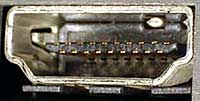 HDMI link
- High-Definition Multimedia Interface. A new connection standard for feeding signals from sources to output devices in digital format. This carries both uncompressed digital video (in a form compatible with
DVI) and uncompressed digital audio. Suitable encryption protocols are implemented on both (that for the video is
HDCP) to resist digital copying. It has a huge bandwidth (up to 5 gigabits per second) allowing it to carry even 1080i video and, at the same time, up to eight channels of 24 bit, 192kHz digital audio. Plus it handles interaction between equipment, easing the way towards true single-remote-control of all devices. From a user perspective, though, it will mean that a DVD player need be connected to a home theatre receiver with just one cable (rather than the up to twelve currently: analogue audio x 6, digital audio x 1, component video x 3, S-Video x 1, composite video x 1). The receiver will then, presumably, provide a DVI output to on-forward the video to the display device.
-
HDTV link
- High Definition Television. While
Standard Definition TV provides the same vertical
resolution as Australia's existing
analogue PAL system (576 visible lines), HDTV will provide greater resolution. Broadcast digitally under the DBV standards, in Australia HDTV has been specified to be 576 line progressive, 720 line progressive or 1,080 line interlaced.
-
Helical scan link
- A system of recording tracks of data or signal onto magnetic tape in which the tape is wrapped partway (up to about three quarters) around the circumference of a spinning cylinder. The cylinder houses one or more reading and writing heads. The tape is also drawn linearly across this contraption. This results in the tracks being written diagonally across the face of the tape. It has the advantage of allowing an effectively higher relative speed of tape to head, allowing a much greater density of data to be held on the tape than a linear system. Used by
VCRs and
DAT.
-
Hertz link
- Cycles per second – a measure of
frequency. Young healthy humans can hear from around 20 hertz to around 20,000. Frequencies lower than that can often be detected by other parts of the body.
-
Hi Fi link
- High Fidelity. This is a tricky set of four letters. 'Hi fi' is frequently used a generic noun for any stereo sound system. But it should more properly be regarded as an adjective, taking due note of the Latin roots of the word fidelity, which means 'truth'. Originally high fidelity described a sound reproduction system that gave a more accurate rendition of the recording than was commonly available. The greater the accuracy, the higher the fidelity. Some
audiophiles mistake pleasing sound for accuracy. I use it in the original meaning. Note that in absolute terms, it changes over time. As audio systems improve, so do those properly described as 'high fidelity'. A very fine high fidelity system from 1970 would not qualify for the term today.
-
High pass filter link
- An electrical circuit that impedes signals below a particular
frequency. In other words, it lets signals above that frequency pass through. An example is the circuit in a home theatre receiver that stops deep
bass from going to a centre channel
speaker. Compare
low pass filter and
bandpass filter.
-
Home theatre receiver link
- A multichannel
amplifier with a digital decoder and tuner built in. The decoder always provides at least
PCM and
Dolby Digital decoding, and almost always
DTS as well. A few also incorporate
MPEG audio decoding.
-
Horn loaded driver link
- A
loudspeaker driver in which a horn is placed over the front of the driver. The primary advantage of this is to increase the
efficiency of the transfer of mechanical energy from the driver to the air. However it usually results in reduced
dispersion of sound, particularly for higher frequencies which tend to be 'beamed' from the horn, and can
colour the sound. Nevertheless, some speaker makers have specialised in using horns, especially
Klipsch, and they are frequently used in professional sound-reinforcement installations. The increase in efficiency can be quite marked. Klipsch loudspeakers tend to offer around nine
decibels higher output than equivalent non-horn loaded loudspeakers, which means they can produce the same output from just one eighth of the
power required for conventional speakers. This can, in turn, mean lower
harmonic distortion because driver
excursion is significantly reduced.
-
Hybrid discs link
- Optical discs which provide more than one format. Many
SACDs are hybrid, consisting of two layers. One layer carries SACD-only audio while the other carries
CD-only audio, providing considerable versatility for these discs. Most
DVD Audio discs are hybrid in the sense of carrying material suitable for both DVD Audio and
DVD Video players. However with most of these the capability is provided by logical organisation rather than physically separate layers or the like. Recently there have been experiments conducted with providing hybrid DVD/CDs, with the DVD material on one side and the CD material on the other.
-
Hybrid loudspeakers link
- Loudspeakers in which two significantly different driver technologies are used. For example (and most commonly), loudspeakers which use
electrostatic panels for midrange and
treble combined with conventional bass drivers.
-
Hz link
- Hertz. (See hertz).
-
 IEEE1394 link
- The formal name of a high capacity
digital connection standard, capable of delivering up to
400mb/s. Frequently used for transferring video and audio from digital video cameras to
DVD recorders and computers. Also known as
Firewire (Apple Computer's name) and
i.link (Sony's name).
-
i.link link
- Sony's name for a high capacity
digital connection standard, capable of delivering up to
400mb/s. Frequently used for transferring video and audio from digital video cameras to
DVD recorders and computers. Also known as
Firewire (Apple Computer's name) and
IEEE1394 (the formal name).
-
Imaging link
- The sensation produced in a
stereo or
surround system of sounds coming from between the loudspeakers. The imaging is described in various
subjective ways relating to how tightly focused those sounds appear, whether they seem to offer a fore-aft depth, whether they give an impression of height as well as width and depth.
-
Impedance link
- A measure of electrical
resistance and reactance. These are the properties of a component that limit the amount of
current that can flow through a circuit. Resistance affects the
DC part of the electrical current, while reactance affects the AC part. Measured in
ohms.
-
Infinite baffle link
- Another term for
acoustic suspension. The term is descriptive, in that if the
baffle of a
loudspeaker were to be infinitely extended in all directions, there could be no movement of air between the front and back of the
driver. Of course, with a real infinite baffle speaker the baffle is wrapped around into a convenient package.
-
Infrasonic link
- Audio tones of
frequencies lower than capable of being detected by the human ear, generally below 20
hertz.
-
Interconnect link
- The cables used to transfer an analogue line level signal from a source component in a home entertainment system to an
amplifier or recording device. Thus a set of interconnects is commonly used to plug a CD player into the analogue inputs of a
home theatre receiver. They are normally two sets of electrically
shielded cables with RCA plugs on each end, however some systems have adopted the
XLR plugs and sockets used in much professional equipment.
-
Interlace link
- The two
fields that constitute a TV
frame each have only half the number of lines of a whole frame (576 visible lines for
PAL, 480 for
NTSC). One field has the odd numbered lines, the other has the evenly numbered ones. One field is first displayed, followed by the other, before the system moves onto a new frame. On the screen, though, the lines of each of these two fields alternate, or are interlaced. Because of the lingering glow of the TV's phosphors and the phenomenon of
persistence of vision in our eyes, we see the two fields as one frame.
-
Integrated amplifier link
- An
amplifier consisting of both a
preamplifier and a
power amplifier.
-
Intermodulation Distortion link
- If two tones are produced at the same time as each other, they can interact in a piece of equipment to produce other tones. Those tones are the sum and difference between the two original tones and, consequently, are generally not
harmonics of either tone. As such, intermodulation distortion is generally more audible, and objectionable, than
harmonic distortion. If the standard SMPTE test tones are applied (60
hertz and 7,000 hertz sine waves), then you can expect to see intermodulation distortion peaks at 6,940 and 7,060 hertz. In practice, small levels of harmonic distortion in the original signals will lead to other IM peaks, so you might see one at 6,880 hertz (ie. 7,000 - 2 x 60) and so on.
-
 Jitter link
- Jitter is the phenomenon of a drift in the
digital audio data delivered so that it does not precisely match the
sampling frequency, causing confusion in the receiving equipment as to the appropriate value of the sample. A host of allegedly audible problems with
CDs and other digital formats have been laid at the feet of jitter. In my view this is considerably overstated. Jitter was a problem in the early days of all-digital production studios because each piece of equipment would have its own circuit to generate a digital
clocking signal, and these would tend to drift apart from each other. The results were sometimes subtle, as when they resulted in dropped
samples (due to the receiving device reading a little more slowly than the source). But they were equally likely to be obvious as a result of the source running more slowly than the receiving device. From time to time a 'zero' sample would result, producing an audible click in the sound. Professional studios have long-since overcome these early problems by providing a standard clocking signal source which controls all equipment, ensuring that they remain fully synchronised. For consumer equipment connected using the universal
S/PDIF standard, there is equally no problem. The source always runs in master mode, providing the clocking signal to the receiving device (for example, a
home theatre receiver) which always runs in slave mode with its timing locked to the incoming clocking signal.
-
JPEG link
- Joint Experts Picture Group. A digital still picture
compression format that achieves high ratios of compression by discarding picture detail, considered by its algorithms to be imperceptible.
-
 kB link
- Kilobyte. A measure of memory storage, a kilobyte equals 1,024
(ie. 210)
bytes.
-
kb/s link
- or kbps -- Kilobits per second. A measure of the data flow rate for
digital audio from a DVD. Stands for thousands of
bits per second. Generally, the higher the number the better the quality.
-
kHz link
- Kilohertz. A measure of frequency: 1,000
hertz.
-
Kell Effect link
- TVs produce their pictures by shooting electron beams across a vacuum tube to its flat, or flattish, end. This end is coated in stripes of phosphor which glow red, green or blue (thus
RGB) when hit by the beams. However the relevant beam does not always hit the relevant bit of phosphor so some
resolution is lost. This is termed the Kell Effect. Some books claim that this can reduce resolution by around 30%, but I suspect things have improved a lot since then.
-
 Laserdisc link
- On optical disc, 30cm in diameter, used to carry movies. The video signals are held in
analogue form, while the audio signals were originally
FM encoded analogue, but later were in
PCM digital and later still in
Dolby Digital or
DTS.
-
LCD link
- Liquid Crystal Display. Seen on digital watches and notebook computers, tiny versions of these are now incorporated into many projectors which can be used in home theatre applications. Some
RPTVs also use them. They are increasingly being used for large
direct view panel displays.
-
LCOS link
- Liquid Crystal On Silicon. A form of liquid crystal display panel used in projectors. Unlike normal LCD panels, the light does not shine through these but reflects from their surface. This allows the enabling electronics for each pixel to be placed behind, rather than around, the
pixel, allowing a greater pixel density for a given panel size, and reduced border widths for effective elimination of the
screen door effect.
-
Letterbox link
- This can have two meanings. The first is a movie in
widescreen format. When displayed on a standard
4:3 TV, this means it will have black bars on the screen at the top and bottom. The second is the presentation of a widescreen movie on DVD in a
non-anamorphic format. This second sense is not consistently used, but should be.
-
LFE link
- Low Frequency Effects channel, sometimes imprecisely known as the subwoofer channel. This carries audio information covering
frequencies up to 120
hertz and is designed to provide a substantial foundation to the bomb blasts, rumbling trucks and the like in movies.
-
Linearity link
- In any home entertainment system, at each stage the input and output signals should be precisely proportional to each other (except where specifically provided such as
RIAA equalization or
Dolby noise reduction). Thus if a momentary 0.5
volts is fed to the input of an
amplifier and it produced a three volt output at its speaker terminals, then a momentary 1.0 volt input should produce a six volt output. Any other output means that there is a non-linearity which will manifest itself as
harmonic distortion. Another example relates to
digital to analogue converters. Each particular
quantization level in a
PCM digital signal has a precise
analogue voltage level associated with it. Any variation means distortion.
-
Line flicker link
- With the
interlaced display systems most commonly in use, horizontal lines and edges shown on the screen can appear to flicker up and down rapidly. That's because every second line is only being display once in one fiftieth of a second. This problem is resolved in the
PAL world by using the more expensive 100 hertz TV sets instead of the standard 50 hertz sets.
-
Line level link
- An electrical signal at a voltage level suitable for transferring a signal between components of a home entertainment system (for example, CD player to
amplifier, amplifier to VCR). Most modern equipment operates with a maximum of level of not much more than two
volts RMS. Line level signals demand high
impedance inputs. At least 10,000 ohms is suitable, although the de facto standard is 47,000 ohms.
-
Lossy compression link
- A common term for a system of
compressing data using
perceptual encoding.
-
Loudness control link
- A sad, sad circuit on a preamplifier that boosts the
bass and, to a lesser extent, the treble of an audio signal. The idea was to overcome the reduced sensitivity of the ear to bass and treble at low volumes, but in fact this could only be achieved with any degree of realism by providing a complex means of calibration, which was never actually provided.
-
Loudspeaker link
- A device for transforming electrical energy into acoustic energy (ie. vibrations in the air). A loudspeaker normally consists of one or more
drivers, a crossover network and an enclosure.
-
Low pass filter link
- An electrical circuit that impedes signals above a particular
frequency. In other words, it lets signals below that frequency pass through. An example is the circuit in a home theatre receiver that allows
bass frequencies to go to a
subwoofer. Compare
high pass filter and
bandpass filter.
-
LP link
- Long Play record. The vinyl record that was introduced in the early 1950s to replace the shorter-play records previously used. Rather than their 78 rpm rotational velocity, the LP rotated at 33 1/3 rpm and used narrower grooves. Accordingly, it gave a playing time of between 15 and 30 minutes per side, depending on the how heavily the signal was modulated, the amount and character of its
bass content and the amount of material available.
-
LPCM link
- Linear Pulse Code Modulation. For all practical purposes, the same as
PCM. This tends to be called LPCM when dealing with DVDs.
-
LSB link
- Least Significant
Bit. The bit of the binary number that varies the value of the binary number by no more than one (which is why it is the least significant). This bit is often randomised in
PCM digital audio in order to add dither to the signal.
-
Luminance link
- The brightness or black and white component of a TV picture. It is created from the original
RGB source signal by adding the three colours together in the correct proportions (0.3, 0.59, 0.11 respectively) to produce grey shades that more or less match the level seen by the human eye. On DVDs the luminance signal is encoded separately to the colour signals and, with some TVs, can be kept separate via
S-Video or
component video cables all the way to the TV, avoiding cross interference between the luminance and colour signals. If a component video connection is used, the luminance connector is identified by its green colour and a marking of 'Y'.
-
 Macrovision link
- A copy protection system incorporated into most pre-recorded video tapes and DVDs. A signal is added into a part of the video signal that is not otherwise used. For video tapes this is recorded on the tape as part of the movie, for DVDs it merely consists of a single code that tells the DVD player add the macrovision signal. When this is detected by a VCR which has been set to record, the VCR interferes with the video signal by randomly varying its brightness, giving a very poor quality of transfer. DVD recorders also recognise the signal, but when they do they refuse to record and advise that the source is copyright protected.
-
Magnetic cartridge link
- A
turntable cartridge that produces the signal by moving a magnet within a coil
(moving magnet cartridge), or vice versa
(moving coil cartridge).
-
MB link
- Megabyte. A measure of memory storage, a megabyte equals 1,024
kilobytes or 1,048,576 bytes. However, if used as a measure of hard disk storage, the 'mega' prefix normally means a round million.
-
Mb/s link
- or Mbps -- Megabits per second. A measure of the data flow rate for
digital video from a DVD. Stands for millions of
bits per second. Generally, the higher the number the better the quality.
-
MC cartridge link
- Moving Coil cartridge. (See Moving coil cartridge.)
-
Memory stick link
- A small, removable flash memory (ie. non-volatile) cartridge developed by Sony, used in a host of digital storage situations, notably in digital cameras and digital audio players.
-
Metadata link
- A set of 'flags', or predefined digital
bits, carried in a
Dolby Digital bitstream that provide instructions to the decoder. They do not carry actual audio data, but guide the decoder in the interpretation of the audio data. Examples include a flag for
dialog normalization and some for
dynamic range control.
-
MHz link
- Megahertz. A measure of
frequency: 1,000,000
hertz.
-
Midrange link
- The audible frequencies typically constituted by
frequencies of between 150 and 5,000
hertz, although the dividing lines between midrange and bass at the bottom end, and midrange and treble at the top end, are ones of opinion. The human ear is most sensitive to midrange frequencies.
-
Midrange driver link
- A middle-sized
driver designed to reproduce the important
midrange
frequencies between the bass and treble notes. If this is omitted, the
loudspeaker is called
'two-way'. If present, along with a woofer and a tweeter, it's called
'three-way'. Some loudspeakers use a midrange driver that looks identical to the two or more woofers in the speaker box. However these drivers are usually tuned differently.
-
Minidisc link
- A
digital audio music delivery system using a disc mounted inside a small, robust plastic cartridge. The audio is encoded using
ATRAC. Interestingly, the audio may be carried on the disc in two different ways. Sony designed it both for acting as a recorder, and playing back commercially-produced Minidiscs. So in the former role it acts as a magneto-optical recorder. For the latter, it uses discs which have been pressed in a similar manner to commercial CDs.
-
MLP link
- Meridian Lossless Packing. A digital audio standard used for DVD Audio. Also known as Packed
PCM or
PPCM. This provides superb sound, from mono through to
multichannel, with a number of technical advantages over
Dolby Digital and
DTS. The middle word, 'Lossless', is important. It is not a
perceptual encoding system that abandons some of the original source material to achieve space savings. It preserves the original signal perfectly, even through multiple encoding/decoding cycles.
-
MMC link
- Multimedia Card. A small, removable flash memory (ie. non-volatile) cartridge, used in a host of digital storage situations, notably in MP3 players. This seems to be going out of favour.
-
MM cartridge link
- Moving Magnet cartridge. (See Moving magnet cartridge.)
-
Mono link
- Or Monophonic. Where just a single channel carries all the sound. Even if played back on a system with two or more
speakers, the sound remains mono because the left and right front speakers are delivering identical signals. Contrast with
stereo and
surround sound.
-
Motion JPEG link
- A digital movie
compression format that consists of a sequence of still
frames, each of which has been compressed using the
JPEG algorithms.
-
Moving coil cartridge link
- A magnetic cartridge in which the stylus moves a coil via the cantilever, while the magnet is fixed in position. Moving coil cartridges tend to have lower moving mass than
moving magnet cartridges, but also tend to be lower in output by an order of magnitude. There are, however, high output MC cartridges available that produce comparable levels to MM cartridges. Because the coil must be wired to the outputs, they also tend to be somewhat lower in
compliance than MM cartridges, so are not normally amenable to very low tracking weights (they typically operate best at around two grams).
-
Moving magnet cartridge link
- A magnetic cartridge in which the stylus moves a magnet via the cantilever, while the coil is fixed in position. Moving magnet cartridges tend to have a higher output than
moving coil cartridges, but also tend to have a higher moving mass (possibly reducing their ability to deliver fine detail from record). Because the magnet is able to freely move, MM cartridges generally offer a higher
compliance than MC cartridges, so the cartridges with the very lowest tracking weights (0.75 to 1 gram) come from the MM camp.
-
MP3 link
- MPEG 1 Layer 3. This is a
digital audio
compression standard that achieves high levels of compression of mono or stereo sound through
perceptual encoding techniques. Close to CD quality sound can be achieved for most kinds of music with only 9% of the data carried by a CD, making this format good for Internet music transportation and small portable solid-state players. While MP3 supports
bit rates of 8 to 320 kb/s, the most common encoding rate is 128 kb/s.
-
MPEG link
- Motion Picture Experts Group. In practice, this stands for a number of audio and video
compression standards. The video on DVDs is compressed according to the MPEG-2 standard, which permits not only compression of each single frame of the picture, but higher levels of compression by comparing frames with each other and only encoding their differences. MPEG audio also appears on some DVDs. This permits up to 7.1 channels of audio to be encoded, although only 5.1 channels is ever seen in practice and its use is now obsolete.
MP3 is one particular form of MPEG stereo.
-
Multichannel sound link
- Often called
surround sound. Any system designed to deliver more than two channels
(stereo) of sound to the consumer. The most common forms these days deliver
5.1 channels of audio. Some systems can process two channels, or even one channel, of sound to produce the effect of multichannel sound.
-
 Noise shaping link
- A system of adding
dither noise to a
digital audio signal so that it is biased towards high
frequency noise. This permits the noise floor to be lower in the range of frequencies to which the ear is most sensitive, at the cost of poorer noise performance in the higher frequencies where the ear is less sensitive.
Read more.
-
Nominal impedance link
- A specification of the load a
loudspeaker places on an
amplifier, measured in
ohms. It tends to oversimplify the actual situation because the impedance of a loudspeaker varies according to
frequency. So a speaker with a nominal impedance of eight ohms may actually present a load of six ohms at some frequencies and thirty ohms at others. Common loudspeaker impedances are four, six and eight ohms. Back in the 1960s, higher impedance speakers -- 16 and 32 ohms -- were fairly common.
-
NTSC link
- National Television System Committee. The television system used in several countries, most notably the United States and Japan. It is substantially different from Australia's
PAL system. Rather than 25
frames, or 50
fields, per second, it uses 30 frames or 60 fields. Instead of 576 visible lines, it produces 480 (on a timing signal equivalent to 525 lines). It also uses a different colour coding system. While the PAL colour system automatically compensates for drift in the colour information, NTSC doesn't. That's why NTSC TV sets have a 'Hue' or 'Tint' setting in addition to the familiar 'Colour' one. That's also why NTSC is sometimes waggishly known as Never Twice the Same Colour. For films on DVD, there are issues with NTSC relating to the requirement for
3:2 pulldown.
-
 Octave link
- A range of
frequencies of some form of repetitive wave, where the highest frequency is precisely twice the lowest frequency. In music, for example, the
fundamental frequency of A below Middle C is 220
hertz. The A above Middle C is 440 hertz.
-
Ohm link
- A unit of electrical
resistance or impedance. In a
DC circuit, the number of ohms of resistance offered by a component can be calculated by dividing the
voltage across the component by the
current (in amps) flowing through it.
-
Optical digital link
- A method of communicating
digital audio between components using light carried on optical fibre. See
TOSLink. The data format accords with the
S/PDIF specification.
-
Optical soundtrack link
- The traditional medium for carrying a film's soundtrack. The sound was converted to markings which were developed onto the edge of the film. The majority of optical soundtracks were
analogue (in the form of squiggly lines, like the track on an
LP). However
Dolby Digital is also carried on the film in optical form. Rather than replacing the analogue soundtrack (which is left on for broad compatibility), the Dolby Digital data is optically recorded between the sprocket holes on the edge of the film.
-
OSD link
- On Screen Display. The menus and information screens shown by TVs, DVD players, VCRs and some home theatre receivers on the TV screen. These make setting up these devices somewhat easier than those devices that lack them.
-
Overscan link
- In order to make sure the sides of the picture form nice vertical lines, and to use the whole screen, TV makers tune their sets so that a little bit of the picture flows off the visible screen on all four side. If this overflow is too much you might be missing something important. The overflow is called 'overscan'.
-
Overtone link
- See harmonic.
-
 PAL link
- Phase Alternating Line. The television system used in Australia, most of Europe and India. This runs at 25
frames or 50
fields per second and produces 576 visible scan lines. It is often referred to as having 625 lines, but some of these are merely timing lines at the start of each field. Some of these lines can also carry Teletext information and switching signals. Technically, PAL refers to the colour system used rather than the field rate and
resolution of the system, but given the ubiquity of PAL across parts of the world, even a monochrome TV based on this rate and resolution tends to be called PAL.
-
PAL60 link
- PAL60 is a television format that is sort of a hybrid of
NTSC and
PAL. It is used in many VCRs and DVD players to convert NTSC signals to PAL, sort of. Basically it leaves the signal in standard NTSC format (that is, 60 fields per second and 480 visible lines) but converts the colour signal into the format that PAL TVs can handle. Many older TVs that could not display NTSC signals could handle PAL60 (a standard NTSC colour picture shows on these TVs in black and white). Some of these need to have their vertical hold control adjusted to stop the picture from rolling. Some TVs can't handle either NTSC or PAL60. Why not convert the picture to PAL completely? Converting the colour standard is a relatively trivial exercise. Converting the number of lines and scan
frequency is a much harder undertaking. The professional equipment used to convert US TV shows to PAL for Europe and Australia costs tens of thousands of dollars. In recent years an increasing number of DVD players will do full NTSC to PAL conversion, sometimes with excellent performance, sometimes rather poorly. The poor ones typically produce a very jerky result.
-
Pan and Scan link
- This is the technique used to crop a widescreen movie so it fits onto a standard TV with a
4:3
aspect ratio. Since the early 1950s most movies released to the cinema have been presented with a 1.66:1 to 2.35:1 aspect ratio. If these were presented on a standard TV in this way, there would be black bands at the top and bottom of the screen. So the edges of the picture are cut off. In some movies, though, the action might be over near, say, the left edge of the screen. In such cases the left part of the picture is presented and the right cut off. As the action moves towards the centre, the cut picture usually follows it. With DVDs most movies are presented in their original
widescreen format. However the DVD specification permits widescreen movies to be encoded with invisible crop marks which can be interpreted by the DVD player and thus performs the cropping itself. Very few DVDs are so encoded.
-
Passive loudspeaker link
- A
loudspeaker without built-in
amplification for all the drivers. Most loudspeakers are passive, not
active.
-
Passive subwoofer link
- A
subwoofer without built-in
amplification. Most subwoofers are
active, not
passive.
-
PCM link
- Pulse Code Modulation. This is standard, uncompressed
digital audio of the kind that is on compact discs. However while normal CDs are always encoded with 16
bits and 44,100
hertz
sampling rate, on DVD bit depths of up to 24 and sampling rates of up to 96,000 are permitted.
-
Perceptual encoding link
- A
compression technique for digitally recorded sound.
Digital audio does not compress at all well using conventional 'non-lossy' schemes because there is very little redundancy in the data stream. Perceptual encoding techniques rely on extensive psycho-acoustic analyses of how the human ear and brain detect and interpret sound. In essence they manage to achieve high levels of compression by discarding elements of the sound that such analyses suggest cannot be heard. In this way they can reduce the data volume of the sound by a factor of 10 or more without obviously degrading the sound quality. Examples of perceptual encoding compression systems are
Dolby Digital,
DTS (although DTS claims that it first uses non-lossy compression techniques to reduce or eliminate the need for perceptual encoding),
MP3,
SDDS, Windows Media, RealAudio and
ATRAC.
-
Period link
- In relation to a repeating wave form, the reciprocal of the
frequency (ie. 1/f).
-
Persistence of vision link
- A very short lingering of an image in the eyes and brain of a person. It is this which allows the continuous stuttering of still images at the cinema to look like smooth motion.
-
Phase link
- The alignment or otherwise of two signals in time. 'In phase' means that they are aligned. 'Out of phase' means that one or the other is shifted in time by one half the period (inverse of
frequency) of the tone in question. If an out of phase pair are played together, they will cancel each other out. Phase is usually measured in degrees. A zero degree shift is in phase, while a 180 degree shift is out of phase. Causes of phase shift include filters (especially those in loudspeaker
crossover networks) and the (lack of) time alignment of drivers in a
loudspeaker.
-
Phono link
- From
phonogram. An adjective relating to systems for playing vinyl recordings, such as
LPs. Thus the phono input of an amplifier is the input into which a
turntable is plugged. This is usually equipped with an RIAA equalization circuit.
-
Phonogram link
- An old name for a record player, that is, a combined system with
turntable,
amplifier and
speakers, usually all contained in one cabinet.
-
Picture resolution link
- How much detail appears in the picture. This is a function of how many
pixels are devoted to the picture. The more dots, the finer the detail. As computer and television technology draw closer together, there's a problem with defining resolution. Traditionally the vertical resolution of TV has been expressed in terms of lines.
PAL has 576 visible horizontal lines
(NTSC has 480). This is easy to understand because these are the scan lines built into the signal. Traditionally TVs don't produce all of these lines because of
overscan and because of the
Kell Effect. For TV, the horizontal resolution has also traditionally been expressed in terms of lines, in this case vertical ones. This is a fairly subjective judgment based on density of closely spaced lines that can be perceived on a screen. DVDs, deriving from computer technology, are instead expressed in terms of pixels. PAL ones have a vertical resolution of 576 pixels (subject to letter boxing, and 480 for NTSC). They also have a theoretical horizontal resolution of 720 pixels. At least, that is the resolution at which the pictures are encoded on the DVD (both for PAL and NTSC). However the great majority of DVD players do not have digital video outputs. So this horizontal resolution has to be down-converted to a resolution that a TV is capable of handling, typically between 500 and 540. DVD players which incorporate
DVI or HDMI outputs are now appearing. These can deliver the full 720 pixels of horizontal resolution. See
here for more.
-
Piezo tweeters link
- High
frequency loudspeaker drivers that, rather than using conventional voice coils, rely on the ability of some crystalline materials to physically respond to the application of a signal. They are usually
horn loaded. Such tweeters have the advantage of having a very high power handling capability, so they are often seen in professional sound reinforcement installations.
-
Pink noise link
- Random audio noise where the average amount of power is the same for each octave. The power level of pink noise falls away by three
decibels for each increasing octave. Frequently used as a test signal, it more accurately reflects the energy content of real-world audio than
white noise.
-
Pixel link
- Picture Element. This is the unit derived from computer terminology to specify picture
resolution. A picture element is the smallest dot that can be resolved.
-
Plasma display link
- A flat panel display technology which consists of three tiny cells for each pixel. Each cell contains a gas which, when electrically stimulated, emits ultraviolet light which, in turn, activates a phosphor coating on the edge of the cell facing the viewers. The phosphors for the three cells are selected for red, green and blue light. Plasma displays have the advantage of being relatively modest in thickness (typically around 75 to 100mm including casing). Some models require internal fans for cooling, but for home theatre use those without are preferable to eliminate this source of noise. Older panels may suffer 'burn-in' in which a ghost of the image is retained if left displayed for too long. But this can be easily avoided simply by not leaving menus and the like displayed too long. Some models also incorporate TV tuners and speakers and are thus called plasma TVs.
-
PMPO link
- Peak Music Power Output. This is a fairyland measure of power output, sometimes quoted for home stereo systems. Sometimes figures of well over 2,000
watts PMPO are claimed. This is in the same class of reality as saying my Nissan Nomad van will travel at up to 240 kilometres per hour. It will, but only after it has fallen from a very tall cliff.
-
Port link
- The hole in the
enclosure of a
bass reflex loudspeaker.
-
Power link
- The amount of energy expended per unit time. The common unit is the watt. Power (in watts) in a
DC circuit equals
voltage times
current (in amps). Things are a bit more complicated with
AC. See here.
-
Power amplifier link
- A device that increases a line level signal (typically around two volts into a high
impedance) and boosts it in voltage, while allowing sufficient
current to be supplied to drive low impedance loudspeakers (that is, impedances nominally in the four to eight
ohm range). Most power amplifiers are
analogue in design and most use transistors, although some analogue amplifiers use valves. New
digital amplifiers are appearing which effectively use a form of pulse width modulation,
low pass filtered to reduce the
ultrasonic noise, to drive the loudspeakers.
-
Power supply link
- Within a home entertainment device, the section that provides a suitable
voltage and current for the operation of the device. This typically consists of a
transformer, rectifier (to turn AC into DC) and regulator (to smooth out fluctuations in the voltage).
Power amplifiers in particular are heavily dependent upon the quality of their power supplies, which contribute a significant proportion of their cost and weight.
-
PPCM link
- Packed Pulse Code Modulation. Another term for
MLP. Frequently displayed on the
OSD of DVD Audio players as the audio type for MLP material.
-
Preamplifier link
- Sometimes called 'Control Amplifier'. Nominally this boosts a low level signal to a level suitable for delivering to a
power amplifier, but in these days of fairly high output source components (such as CD players), their main function is to provide a volume control and switch between different sources. Some preamplifiers may incorporate such things as
loudness and tone controls and mute buttons. Many preamplifiers also incorporate a
phono preamplifier which boosts the low level signal (say 5 to 100 millivolts) of a phono cartridge's output and applies
RIAA equalization.
-
Progressive Scan link
- Most video formats are
interlaced, which means that to create a single
frame the first line is scanned, then the third, then the fifth. When the bottom of the screen is reached the signal returns to the top and scans the second, fourth and so on lines. Progressive scan is a system of writing the whole picture in one sweep, first line, second, third, etc all the way to the bottom. Progressive scan is said to provide a noticeably cleaner, sharper and more stable picture than interlaced. While progressive scan appears to offer significant technical advantages for
NTSC DVDs, its advantages for
PAL DVDs appear to have been
significantly overstated.
-
PVR link
- Personal Video Recorder. A device which can record broadcast TV, whether digital or analogue, onto a built in hard disk drive for later replay.
-
 Quantization link
- Or 'quantisation' in Australian. The numerical value assigned to a particular analogue voltage input at an instant of time in an
analogue to digital converter, or the process of making such an assignment. The range of numerical values available, and consequently the accuracy of the assignment, depends on the
bit depth of the PCM system employed.
-
Quantization noise link
- Or 'quantisation noise' in Australian. A form of
harmonic distortion produced in all digital systems. Low level signals do not use all the bits available in the digital system (that's why they are low level signals!) Consequently they operate as though the digital system has a low bit depth (say, an eight bit system or even four). This increases their harmonic distortion. By its nature, harmonic distortion generated by digital systems tends to give relatively high levels of odd-order
harmonics, which are far more irritating than the even order harmonics to which analogue systems tend. This is routinely addressed by adding
dither to digital signals. See more
here.
-
 Rainbow Effect link
- A sometimes irritating optical illusion produces by many
DLP projectors. These are flashes of short tri-colour
RGB stripes that tend to appear away from the centre of vision while watching a movie. They are more apparent during monochrome, or near-monochrome scenes. They appear to be an artifact of the spinning colour wheel used in most DLP projectors. When three-panel DLP projectors become feasible in the home, it is likely that this effect will no longer be a problem because these do not use a colour wheel. Manufacturers have attempted to eliminate this effect by increasing the number of colour filter windows in the wheel and spinning it faster. Recent high quality DLP projectors have certainly reduced the effect until it rarely appears. Apparently not everyone notices the effect. Unfortunately, I'm one who does.
-
RCA plug/socket link
-
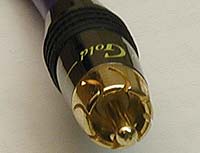 The most common audio and video connection standard. They are used for
composite video (usually with a yellow colour code),
component video (three of them in this case, inappropriately but traditionally marked with red, green and blue colour codes), digital
coaxial and standard audio connections. Sometimes called a 'cinch' plug/socket.
The most common audio and video connection standard. They are used for
composite video (usually with a yellow colour code),
component video (three of them in this case, inappropriately but traditionally marked with red, green and blue colour codes), digital
coaxial and standard audio connections. Sometimes called a 'cinch' plug/socket.
-
Reactance link
- The aspect of impedance which varies according to the frequency of the signal it is affecting. Measured in
ohms.
-
Receiver link
- In the stereo world, an
amplifier with a
tuner built in. Often used as short hand for
home theatre receiver.
-
Region Code link
- A system built into DVDs that is intended to prevent the playback of DVDs from one part of the world in DVD players sold in another part of the world. There are six region codes. Australia is Region 4. The United States is Region 1. Europe and Japan are Region 2. See this
66kB PDF for a discussion of some of the implications.
-
Resistance link
- The aspect of impedance which remains constant regardless of the frequency of the signal it is affecting. In the case of
DC
voltages, the resistance is the same as the impedance. Measured in
ohms.
-
Resolution link
- The amount of detail a system is capable of recording or producing. For digital audio, it is largely determined by the
bit depth. See also
picture resolution.
-
Resonant frequency link
- The frequency at which a system offers the lowest
impedance, allowing the highest power transfer. In the case of physical systems, it is the frequency at which the vibration is greatest for a given input. For
loudspeaker drivers, the resonant frequencies of the drivers are very important characteristics to take into account in the design process, avoiding placing them in the range of operation for higher frequency drivers, and carefully designing the enclosure to make best use of the resonant frequency of the
woofer.
-
Reverberant sound field link
- A speaker system in which a significant amount, perhaps most, of the sound that you hear is coming from reflections from surfaces within the listening space rather that directly from the
loudspeakers. Reverberant sound field speakers tend to have a larger
sweet spot, and produce a more rounded
stereo image with greater depth than
direct sound field speakers. Reverberant sound field sound can be achieved by choosing speakers with a very wide
dispersion, such as
bipole speakers, or by purpose designed speakers from companies such as Bose.
-
RF link
- Radio Frequency. If your TV is plugged into your VCR via the aerial socket, rather than through
A/V and you tune into the VCR using a channel number, the movie you are watching has been radio frequency modulated by your VCR, fed into your TV's aerial socket, and then demodulated by the TV. Avoiding these unnecessary steps is why using the A/V inputs is preferable. If you have a
laserdisc player that is
Dolby Digital or
AC-3 compatible, it's digital output is RF modulated.
-
RGB link
- Red, Green, Blue. These are the colours of the three additive lights signals required to produce all the colours of the rainbow, as perceived by humans. TV cameras use RGB receptors -- they detect the red, green and blue components of the light that they are recording. TV screens show their pictures in RGB, using red, green and blue phosphors (or equivalent) to show the image. All this works because the human eye is equipped with red, green and blue photosensitive cells in the retina. The other colours are formed by different combinations between these three, plus their intensity. Between the TV camera and the TV screen the signal is always converted to some other standard:
component video in the case of
DVD,
S-Video in the case of
S-VHS tape,
composite video in the case of TV broadcasts and standard video tape.
-
RIAA Equalization link
- Record Industry Association of America Equalization. When converting an electrical signal to mechanical motion, there is an inconvenient fact: the lower the
frequency, the higher the
excursion of the moving part for a given signal level. This is important in several fields, particularly with
LPs. The grooves of an LP would wobble very widely if the
bass frequencies were cut in direct proportion to the signal. The playing time would, consequently, be very short and
turntables would have a great deal of difficulty in holding their styli in place within the groove. So before LPs are cut, the signal is subjected to RIAA equalization. This reduces the bass by an enormous amount
(-17dB at 50
hertz), and increases the treble equally hugely (+13dB at 10,000 hertz). A circuit built into the
phono preamplifier of the playback equipment reverses this
EQ, boosting the bass back to its proper level and handily cutting the treble. This last has the welcome effect of substantially reducing the hiss produced by the scraping of the
stylus within the groove. Note: old-style
ceramic cartridges did not require this second step of reversing the EQ because their
frequency response characteristics roughly approximated this anyway.
-
RMS link
- Root Mean Square. This is a measure of voltage or
(incorrectly) power output. The latter is often quoted in the specifications for an
amplifier or home theatre receiver. Measuring voltage is simple with direct current, even if it varies in level. You can simply average the values over time. But alternating current, when arithmetically averaged, gives you a value of zero or close to zero. If you square each value (multiply it by itself) before taking the average, and then take the square root of that average, you not only get a reasonable representation of the voltage, but a value that provides effectively the same amount of power as a similar DC voltage into a resistive load. What is called 'RMS power output' for amplifiers is calculated using the RMS voltage delivered by the amplifier to test loads, so in that sense the term is not entirely misleading (however something like 'average sine wave power output' is far less irritating). Such figures should include a measure for the amount of
distortion generated at that power. This should be well under 0.5%. If the figure is 10% (often used with home entertainment systems) the figure should be discounted substantially.
-
RPTV link
- Rear Projection Television. A large screen TV which does not use a
direct view CRT, but three single-coloured CRTs, the light from which bounces off a mirror within the TV and illuminates a flat translucent screen from behind. Some newer models use
LCD or DLP projectors rather than the CRTs.
-
Rumble link
- Low frequency noise, usually from a turntable. Given that
RIAA equalization boosts the bass signal from a
cartridge by an enormous amount (17dB at 50 hertz), the highest quality bearings and excellent isolation from the turntable's motor are required to control rumble.
-
Running in link
- A frequently recommended process for the installation of new equipment. Essentially, running in is operating the new equipment for some hours, or tens of hours, to bring it up to peak performance. As with many such areas of performance, there is both validity and silliness in this. Loudspeakers are physical systems with suspensions and surrounds that do benefit from being run in. But running in speaker cables achieves precisely nothing. Those who claim that their speaker cables sounded better after being run in are imagining the improvements. Of course, I could never prove this because A-B testing is impossible.
-
 SACD link
- Super Audio CD. A new audio format developed by Sony and Philips. This takes on
DVD Audio by offering very high
resolution sound, using
DSD digital encoding. SACDs can deliver up to 5.1 channels of sound, but even if they do they are required by licence to also carry a two channel sound track. SACDs are most commonly made in a two layer
hybrid format. One layer provides SACD music
(stereo and, optionally,
multichannel) while the other is fully compatible with CD players. The SACD specifications also provide for some video-carrying capability, but neither disc nor player offering this has yet been seen.
-
Sample link
- One from a series of
digital measurements taken of an
analogue signal at regular intervals. The timing of the intervals is determined by the
sampling frequency. The accuracy of the sample is determined by the sample's
bit depth and the quality of the
ADC.
-
Sampling frequency link
- The number of
digital
samples taken each second of an
analogue audio signal. For the compact disc, this is always 44,100 samples per second (usually expressed as
hertz). For DVD it is typically 48,000 hertz, but may be 96,000. The higher the figure, the more accurately the analogue source is recorded, giving an extended high
frequency response, and the more space the signal requires.
-
Satellite speakers link
- Small loudspeakers designed to deliver only midrange and high
frequency audio. They are intended to operate in conjunction with a
subwoofer which delivers the bass.
-
SBM link
- Super Bit Mapped. An
analogue to digital conversion system developed by Sony that incorporates a form of
noise shaping, designed to deliver very good performance results in the middle
frequencies, at the cost of a poor
signal to noise ratio in the high frequencies.
-
Scan lines link
- A TV works by sweeping its electron beams from one side of the screen to the other, then repeating this just below the line it has just drawn, and so on from the top to the bottom of the screen. With
PAL systems, this creates 576 visible lines (480 for
NTSC). These are called scan lines. If your screen is big and you are sitting too close to it, you can sometimes actually see the scan lines. This is rarely a problem on standard
CRT TV sets, but often a problem with
rear projection TVs. The solution is to sit further away or get a smaller, or better designed, viewing device.
-
SCART link
-
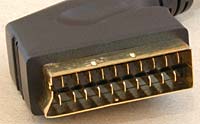 Syndicat francais des Constructeurs d'Appareils Radio et Television. A large connector, carrying 21 pins, designed to connect VCRs and DVDs to TVs. The cable has the convenience of carrying both audio and video. Most modern SCART-fitted equipment can use the cable for
composite,
S-Video and
RGB video signals, switching between the latter two within some kind of setup menu. Some recent models also support
component video on the same cable, once again after setup switching. SCART connections are mostly found on higher-end European TVs, matching DVD players, and a few Japanese DVD players aimed at the European market.
Syndicat francais des Constructeurs d'Appareils Radio et Television. A large connector, carrying 21 pins, designed to connect VCRs and DVDs to TVs. The cable has the convenience of carrying both audio and video. Most modern SCART-fitted equipment can use the cable for
composite,
S-Video and
RGB video signals, switching between the latter two within some kind of setup menu. Some recent models also support
component video on the same cable, once again after setup switching. SCART connections are mostly found on higher-end European TVs, matching DVD players, and a few Japanese DVD players aimed at the European market.
-
Screen Door Effect link
- The visual effect of a projector (typically LCD) showing the video with a thin black border around each individual
pixel. See
this article for more.
-
SD link
- Secure Digital. A small, removable flash memory (ie. non-volatile) cartridge, used in a host of digital storage situations, notably in digital cameras and digital audio players. Physically it is very similar to the
MMC, but incorporates support for
digital rights management. Major non-Sony Japanese consumer electronics companies tend to support this format.
-
SDDS link
- Sony Dynamic Digital Sound. A discrete channel surround sound system developed by Sony, based on its
ATRAC sound
compression technology for the
Minidisc. It provides eight channels of sound and is optically printed on the film, using the space outside the sprocket holes. The eight channels are allocated as
LFE, surround left, surround right, and five front channels. This adds a centre left and centre right channel to the three front channels provided by other systems. SDDS is used only in cinemas, not home theatre. It uses
perceptual encoding compression techniques to reduce the amount of data space required to carry the signal. The home page for SDDS is
here.
-
SDTV link
- Standard Definition Television. A TV transmission standard that uses digital technology to supply a picture of similar
picture resolution to Australia's existing
PAL system.
-
Seamless layer change link
- With dual layer DVDs there is normally a pause partway through the movie as the laser reaches the end of one layer and has to refocus on the other layer and find the correct starting point. However some DVD players eliminate this pause by reading ahead somewhat and providing a buffer memory that fills in the pause. Some DVDs (notably the SuperBit titles) also manage this feat on their own by some mechanism I do not understand.
-
SECAM link
- Sequentiel Couleur a Memoire. The television system used in France. It is very similar to
PAL (the same
frame rate and
resolution) but uses a different colour encoding technique in transmission (the colour is
FM modulated). This is said to have some technical advantages over PAL, but some think it was imposed in France primarily to ensure that French TV was incompatible with the rest of Europe, ensuring a good market for French-made TV sets. Since most good quality TVs are these days multi-standard, this is no longer a consideration. The colour encoding differences only apply to broadcast signals, so the video on DVDs made in France for French TVs is identical to that on the DVDs made for PAL TVs.
-
Sensitivity link
- A measure of the efficiency with which loudspeakers turn the electrical energy provided by a
power amplifier into acoustic energy. The more sensitive, the greater the volume for a given amount of power. This is normally measured as the
sound pressure level in decibels (dBSPL) achieved by the loudspeaker in an anechoic chamber at a distance of one metre with a 2.83
volt 1kHz signal applied. (2.83 volts is the voltage required to deliver one
watt to an eight ohm load.) Using my own methods, I have measured sensitivities ranging from not much more than 80dB to nearly 100dB. Each 3dB increase in sensitivity is equivalent to doubling the amount of power, so for a loud system it is far better to choose sensitive loudspeakers rather than pay for a higher-powered amplifier.
-
Separation link
- A measure of the degree to which leakage from one channel of sound to another channel
(crosstalk) is limited. This is typically measured in
decibels (eg. -90dB at 1kHz). While great emphasis is placed on this figure, the reality is that very modest figures like -20 or -30dB (typical of
LP records) provide excellent stereo separation and imaging. More important is that the separation should not vary widely between different
frequencies, since this could lead to a positioning mismatch between the
fundamental and harmonic frequencies for particular instruments.
-
Shadow mask link
- A part of a
CRT TV tube. This is a barrier within the tube, placed between the electron guns at the narrow end and the phosphor screen at the wide end. It consists of plate with thousands of perforations. The geometric arrangement permits the electrons emitted for each colour gun to activate only its matching colour phosphors. This is an alternative to the
aperture grille.
-
Shielding link
- A finely woven mesh of thin wires, or a conductive foil wrapping, around a signal cable under the outer layer of insulation. The shielding is earthed and acts to protect the signal-carrying wires within from electrical fields which could introduce noise into the signal.
-
Signal to noise ratio link
- A specification for the level of noise produced by a system. This is normally expressed in the
decibel difference between the measured noise and some reference signal.
-
Sine wave link
- An electrical signal or tone that follows a sinusoidal shape. The shape is ubiquitous in nature. All repeating waves can be generated by a combination of a sine wave with various
harmonics of that wave (see
Fourier).
-
Skate link
- The rather unintuitive tendency of the stylus of a turntable
cartridge to seek to slide towards the centre. This is due to the geometry of the
tonearm and results in a greater force being applied to the inner side of a groove than the outer side. Decent tonearms have an
anti-skating device.
-
Smart Media link
- A small, removable flash memory (ie. non-volatile) cartridge, used in a host of digital storage situations, notably in digital cameras and digital audio players. It should be noted that many MP3 players reformat Smart Media cards in a way that will not permit them to be compatible with digital cameras.
-
SNR link
- Signal to Noise Ratio. (See Signal to noise ratio.)
-
Sound Stage link
- A movie set where audio is recorded along with video. But in the home entertainment context, the sound stage is area between a pair of stereo speakers from which they appear to make the various sounds appear. Some speakers manage the feat with some recordings of making the sound stage actually wider than this space, and providing sensations of both vertical sound placement and depth in the stage.
-
S/PDIF link
- Sony/Philips Digital Interface Format. A widely used
digital audio protocol. It is used as the protocol for all consumer home entertainment equipment. It is distinguished from the professional AES/EBU protocol by incorporating the clock timing information in the main signal. Originally designed for 44.1 and 48 kHz and 16
bits, it now carries up to 96kHz and 24 bits, plus the
bitstreams for the various compressed digital audio standards. The connections used are generally
coaxial or
optical.
-
Speaker link
- Short for loudspeaker.
-
Speed of propagation link
- Physical waves, whether sound or electromagnetic, have a typical speed of propagation through various media. This varies depending on the medium. Light travels through a vacuum at
3x10⁸ metres per second. Sound travels through room-temperature air (20C) at 343.5 metres per second. The speed varies slightly according to temperature, increasing to 349.3m/s at 30C, falling to 337.6m/s at 10C.
-
SPL link
- Sound Pressure Level. A measure of volume or loudness in
decibels. 0dBSPL is the quietest that can be heard. A rock concert may produce up to 120dBSPL. The threshold of pain is a little above this. Hearing damage is a function of loudness and the frequency and period of exposure.
-
Square wave link
- A signal, the shape of which when displayed is, well, square. In other words, it holds to a negative value for a time equal to half the wave's
period, then switches abruptly to a positive value which it holds for the same length of time, then switches back negative again, and so on. How quickly it switches between these states is determined by how far into the higher
frequencies the equipment in use can extend. Square waves rarely form part of music, and are primarily used as diagnostic tools, since inspection of how well equipment handles a square wave can reveal a lot about its high frequency handling and whether it shifts
phase across its frequency handling range. For those who are mathematically inclined, a square wave can be defined by the formula, where f is the fundamental frequency and n is an odd natural number: sin(f) + 1/3 sin(3f) + 1/5 sin(5f) + ... 1/n sin(nf).
-
Stereo link
- Or Stereophonic. In the home, an audio system which delivers two channels of music, left and right, to create the illusion of a plane of sound facing the listener. Some carefully produced recordings can use these two channels to also give a sense of fore-aft depth in that space between the
speakers, occasionally generating an illusion of sound even behind the listener. Confusingly, in the professional cinema context, stereo means surround sound. Contrast with
mono and
surround sound.
-
Stylus link
- A small diamond on the end of a cartridge's cantilever. This sits within the groove of an
LP and picks up the vibrations recorded therein. The stylus is generally spherical or elliptical in shape, although some variations have been developed, all with a view to more accurately tracking the groove while reducing damage to it. Elliptical styli are only suitable for tracking weights of less than around two grams because their low contact area with the groove can cause damage.
-
Subjective reviewing link
- Subjective assessment is a vital component in judging any piece of audio equipment. We have not established a set of tests which fully and accurately describe the perceived performance of audio or video components. Particularly with things like
loudspeakers, an experienced listener can come to a valuable view of the performance just from a brief listen. That said, subjectivism does not negate the equal value of objective tests and has far too often been taken to
ridiculous extremes. One giveaway is when the reviewer starts talking about his or her feelings. If a system is claimed to be more able generate an emotion in the listener than another system (except, perhaps, for anger and irritation when it fails to work properly), then it is time to stop reading. Emotions are primarily generated by the interactions between the music, the listener's tastes and the listener's mood. These things will swamp any due to the subtle differences between two CD players or
amplifiers.
-
Subwoofer link
- A
speaker designed to produce only deep bass
frequencies. Most subwoofers are 'active' models, which means that they have an
amplifier built in. 'Passive' subwoofers require an external amplifier. Active subwoofers also have a level control and, usually, an upper
frequency control, although an increasing number are appearing without features not required when connected to a home theatre receiver's
Dolby Digital (or whatever)
LFE output, which covers a frequency band from 3 to 120 hertz. But to achieve useful output from a subwoofer below around 20 hertz, expect to pay big dollars.
-
Surround Sound link
- An audio system which delivers sound from behind, as well as in front of, the listener. This can be artificially generated by 'virtual surround' systems which process a stereo signal to produce the effect of sounds from the rear, even with just two
speakers. More commonly, though, it refers to systems such as
Dolby Pro Logic,
Dolby Digital and
DTS which were designed to deliver specific channels of surround sound from speakers placed slightly behind and to the sides of the listener. These typically also use a centre front channel and, in some newer versions, an additional centre rear channel. In the professional cinema context, surround sound is often called stereo. Contrast with
mono and
stereo.
-
SVGA link
- Super Video Graphics Array. A computer-oriented display
resolution with 800
pixels horizontally and 600 pixels vertically. Often appears in inexpensive projectors.
-
S-VHS link
-
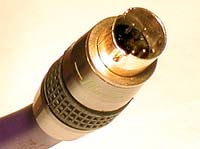 Super VHS. This is a higher standard of video tape recorder, which approximately doubles the amount of horizontal
resolution able to be recorded on video tape (from around 250 lines for VHS to around 400 lines). It also uses the
S-Video system of keeping the colour and luminance parts of the video signal separate, allowing better picture quality. It typically requires an S-VHS tape, which is identical to a standard VHS tape but with better quality magnetic formulation. These tapes sell at quite a premium over regular tapes. The term is sometimes erroneously used (even by equipment makers, who should know better!) for S-Video.
Super VHS. This is a higher standard of video tape recorder, which approximately doubles the amount of horizontal
resolution able to be recorded on video tape (from around 250 lines for VHS to around 400 lines). It also uses the
S-Video system of keeping the colour and luminance parts of the video signal separate, allowing better picture quality. It typically requires an S-VHS tape, which is identical to a standard VHS tape but with better quality magnetic formulation. These tapes sell at quite a premium over regular tapes. The term is sometimes erroneously used (even by equipment makers, who should know better!) for S-Video.
-
S-Video link
-
This is a special cable with four pin connectors at the end designed to carry video. Its virtue is that it keeps the
luminance part of the signal separate from the
chroma part, providing a significantly better picture quality. It is most commonly seen on DVD players and
S-VHS tape recorders, and the TVs for them to plug into. Sometimes the term S-VHS is incorrectly used instead of S-Video. For more on the quality differences between
component video, S-Video and
composite video, go
here.
-
Sweet spot link
- The seating position or positions at which a
stereo or surround sound system produces its best effect, particularly with regard to
imaging.
-
 Telecine link
- TELEvision/CINEma. A device to capture film frames and convert them to a suitable video format. These days the capture is normally performed digitally.
-
Theile and Small parameters link
- Back in the 1960s the Australian engineer Neville Theile and American engineer Richard Small developed a method of modelling
loudspeakers. This was groundbreaking work, allowing the
bass performance of loudspeakers to be explicitly designed, rather than developed through trial and error. Forty years later, their work remains the basis of loudspeaker design. To use their design techniques a number of characteristics of the
woofer to be used must be known. These include such things as the driver's
resonant frequency, its compliance, its 'equivalent volume' and so forth. These are collectively known as the Theile and Small parameters and are stated by all reputable driver makers for those drivers they sell (although not necessarily for drivers that are only sold installed in loudspeakers).
-
Three-way loudspeakers link
- A
loudspeaker which divides the incoming signal into three different
frequency bands for distribution to
drivers. It sends high frequencies to the
tweeter, the middle frequencies to the
midrange driver, and the low frequencies to one or more
woofers.
-
THD link
- Total Harmonic Distortion. (See total harmonic distortion).
-
THX link
- A certification standard controlled and operated by LucasFilm. It covers certification of both cinemas and home entertainment equipment to meet given minimum standards. Originally, on the home entertainment front, there was just one standard: 'THX Certified'. But in recent years this has been replaced by two standards: 'THX Ultra' certification, which is the highest level and is similar to the old standard, and 'THX Select' which is a lesser standard. Note that many brands and products which could easily achieve THX certification decline to seek it for reasons of brand self-respect, or to avoid the cost involved, so THX certification does not necessarily mean that a piece of equipment is superior.
-
Time alignment link
- Systems for ensuring that audio signals from various loudspeakers or drivers arrive at the listener at the correct time. For example, with
surround sound it is important that the sound from the surround speakers not arrive early, even though these speakers are often situated closer to the listener than the main speakers. So home theatre receivers incorporate a system to allow the sound to these speakers to be (adjustably) delayed by some milliseconds. Likewise, some high end
loudspeaker makers will recess the tweeter further into the
enclosure to ensure that the high frequencies arrive at the listener at the same time as lower frequencies, with a view to delivering a more coherent sound.
-
Title link
- The major divisions for content on a
DVD Video disc. Typically the movie is in a single Title, while the trailer is in another Title and so forth. This is the equivalent of a
Group on a
DVD Audio. A Title is normally subdivided into
Chapters.
-
Tone controls link
- Labelled 'bass' and 'treble', fitted to a
preamplifier these provided a means of boosting or cutting the
bass or treble of the signal. They typically provide up to
ten decibels of boost or cut at 50 hertz for bass and 10,000 hertz for treble. Best avoided.
-
Tonearm link
- The long thing on a turntable which is pivoted at the back and at its end has provision for a
cartridge to be attached. These normally provide for an adjustable tracking weight by the use of a spring-loaded or weight-loaded mechanism at the back, and usually have a damped cueing lever to allow the
stylus to be gently lowered to the surface of the record. Over the years some makers have provided parallel tonearms which do not use a pivot, but a motor-driven rack at the back which gradually moves the rear of the tonearm as the width of the
LP is traversed.
-
Toroidal transformer link
- See
transformer.
-
TOSLink link
- DVD players can be connected to digital audio decoders by means of a digital signal cable. One kind uses wires and sends an electrical signal. TOSLink cables use optical fibre and send an optical (or light) signal. More correctly, TOSLink refers to the kind of plug on the end of such cables. This is roughly square shaped with a small ridge to allow it to click into, and be firmly held by, a socket. Some portable
Minidisc recorders and CD players can receive or generate an
optical digital signal but these generally require a cable with a different plug, shaped somewhat like a standard 3.5mm stereo headphone plug.
-
Total harmonic distortion link
- All the
harmonic distortion components added together to give a useful, if imperfect, summary measure. The imperfection resides in the fact that, audibly, some of the harmonic components are worse than others. In particular, odd-ordered
harmonics from the fifth and up are particularly poor. Solid state
amplifiers and the like typically offer
THD ratings of less than 0.1% at rated
power output, although many all-in-one systems cheat by quoting their power outputs at a ludicrous 10% THD. This much distortion suggests that the system has been pushed well into
clipping.
-
Track link
- The divisions within a
Group on a
DVD Audio. Navigation is most easily achieved by using the forward and reverse 'skip' keys of the DVD player's remote control. Alternatively, the divisions within the program material of a
CD or an
LP.
-
Transformer link
- A device used to alter the voltage of
AC electricity. This typically consists of an iron ring of some kind with two coils of wire wound around it. The input current is fed to one of the coils, which generates a magnetic field in the iron ring and which, in turn, generates a voltage in the other coil. The proportion of input voltage to output voltage is the same as the proportion of the number of coil windings on the input (called the 'primary') and output ('secondary'). Most transformers use a square-shaped ring with the primary and secondary windings on opposing sides. Some transformers, which tend to appear in high quality audio equipment, are toroidal, which means that the ring is shaped like a donut and the primary and secondary windings cover the entire surface, overlapping each other. Transformers do not work with
DC electricity because while DC can generate magnetism in the iron core, a magnetic field cannot in turn induce electricity in a wire unless it is changing (or the wire is moving with respect to it).
-
Transmission line link
- A system of tuning the bass response of a loudspeaker
enclosure that involves a labyrinthine internal structure, with a long internal passage between the rear of the woofer and the outside air. This can enhance bass, although it tends to result in significant
phase delays in the deep bass.
-
Treble link
- The audible frequencies typically constituted by
frequencies above about 5,000
hertz, although the dividing line between midrange and treble is one of opinion. The human ear is less sensitive to treble than to midrange frequencies.
-
TRS link
- Tip Ring Sleeve. Another name for a
6.25mm (or 1/4") stereo jack. This terminology tends to be used in professional audio and these plugs tend to be wired for
balanced
mono operation.
-
Tuner link
- A component (or module within a component) that can receive an
AM or
FM radio signal, demodulate it and deliver an
analogue audio signal to an
amplifier.
-
Turntable link
- A device used in a home entertainment system to rotate at the correct speed a vinyl recording, such as an
LP. More generally, the word can refer to the turntable itself along with an installed
tonearm and
cartridge. The platter on the turntable (the rotating part) is powered by a small electric motor. Different types of turntables are defined by the drive mechanism used to connect motor to platter. The three most common types are idler-wheel, belt drive and direct drive. An idler wheel is a rubber-like wheel, perhaps two or three centimetres in diameter, that presses against the shaft of the motor and a rim on the underside of the platter. These are never used in high quality equipment because of speed variations and noise problems. Belt drive turntables use a rubber-like belt or band running around a pulley on the motor shaft and a rim on the underside of the platter. These appear in a wide range of turntables, from inexpensive ones through to some of the most prestigious models available. In direct drive turntables the motor runs slowly and the spindle at the centre of the platter is connected to the shaft. These appear in some very high quality turntables and offer particular advantages of high acceleration to speed, plus electronic speed control, prized by DJs.
-
Tweak link
- A subtle change to a home entertainment system intended to improve the sound. This could range from merely adjusting the system's controls, through replacing cables and experimenting with
speaker positions, to all kinds of weird mystical stuff. See
Belt for examples of the latter.
-
Tweeter link
- A small speaker
driver designed to produce high
frequency (or treble) sounds. This typically operates from 2,000 to 6,000
hertz, depending on the other drivers, up to and sometimes beyond the limits of human hearing at 20,000 hertz. The deeper notes are routed by a
crossover network to the
midrange driver (if any) and
woofer.
-
Two-way loudspeakers link
- A
loudspeaker which divides the incoming signal into two different
frequency bands for distribution to
drivers. It sends high frequencies to the
tweeter and low frequencies to one or more
woofers.
-
 Ultrasonic link
- Audio tones of
frequencies higher than capable of being detected by the human ear, generally above 20,000
hertz.
-
UOP link
- User Operation Prohibition. A control put into a DVD's control program that prohibits the user from performing certain actions at certain points on the DVD. Frequently there are UOPs against jumping back to the DVD's main menu while copyright notices are being displayed. Some particularly irritating DVDs will not allow the audio track to be changes using the 'Audio' key on the remote control. Instead they demand you go back to the main menu. Some DVD players can be modified to escape the limitation of UOPs.
-
UXGA link
- A computer-oriented display
resolution with 1,600
pixels horizontally and 1,200 pixels vertically.
-
 VBR link
- Variable bit rate. As opposed to
CBR or constant bit rate. The flow of
digital data increases or slows over time, according to the complexity of the encoded signal. Has the advantage of allocating more of the scarce data space to those moments of video or audio that most need it, while economising on sections that can get by with less data.
-
VCD link
- Video CD. A movie format popular in Asia in which highly compressed movies can be placed on an optical disc adhering to CD conventions.
MPEG-1
compression is used, which is less effective than the MPEG-2 used on DVDs. Because of the data size limitations of CDs, VCD movies are of much lower
resolution than DVDs and are usually spread over at least two VCDs.
-
VCR link
- Video Cassette Recorder. An
analogue video recording system using tapes in a robust plastic housing. The two principal kinds were
VHS and Beta although the latter is now obsolete and no Beta video recorders are made any more. There is also a higher quality version of VHS, called
S-VHS.
-
VGA link
- Video Graphics Array. A computer-oriented display
resolution with 640
pixels horizontally and 480 pixels vertically. Sometimes appears in older projectors and
LCD displays.
-
VHS link
- Video Home System. A consumer-level
video recording system developed by JVC in the late 1970s. Despite urban legends to the contrary, it was not noticably inferior to Sony's
Beta system (although the latter offered a slightly higher horizontal
resolution of around 300 lines, compared to VHS' 250 lines), which had beaten it to market. Eventually VHS prevailed through having longer record-playback times. There was also an electrically similar, but physically smaller, compact version of VHS called VHS-C for use in digital video cameras.
-
Voice coil link
- The coil of wire that is attached to the back of the cone or dome of a
loudspeaker driver. This is surrounded by a strong, close magnet so that when electricity is fed into the coil, it moves to and fro, moving the attached cone or dome to and fro, generating sound.
-
Volt link
- The standard unit for electrical potential.
-
 Watt link
- A unit of
power. For DC, it is equal to
the current multiplied by the voltage (one watt equals one volt times one amp).
-
Wavelength link
- The end-to-end physical measurement of a cycle in a repetitive signal, measured in metres
(or convenient multiples). Audio wavelengths are generally in the range of 17mm to 17 metres (at air temperature 20C). The human eye responds to light in the wavelength range of 380 to 780 nanometres. The wavelength of a signal can be calculated by dividing the
speed with which the signal propagates through a medium by its
frequency.
-
Weave link
- One of several strategies used in deinterlacing video. Weaving is where the two interlaced
fields constituting the full video
frame are simply 'woven' together without any other adjustment. This is suitable for film sourced video material, since both fields consist of parts of the picture taken at the same time, so no horizontal adjustment is required. Compare with
Bob.
-
White noise link
- Random audio noise where the average amount of power is the same across all audio
frequencies. Sometimes used as a test signal, but it is weak because real audio has power characteristics more like
pink noise.
-
Widescreen link
- Until the early 1950s nearly all movies used the
Academy aspect ratio of 1.37:1. Under the assault of TV from that time on, most cinema released movies were filmed in a widescreen format where the
aspect ratio was from 1.66:1 up to, in some cases, 2.7:1. The most common modern ratios are approximately
1.85:1 and 2.35:1.
-
Widescreen enhanced link
- A picture format used for widescreen movies on DVD. See anamorphic for a full explanation.
-
Widescreen TV link
- Modern TVs (and other display devices) increasing support a display are with a
16:9
aspect ratio. This provides a much better experience when watching modern signal sources, such as DVDs and Digital TV.
-
Woofer link
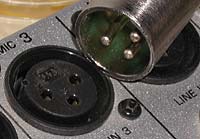
- The largest
driver in a
loudspeaker box, sometimes called the bass driver. This provides the
bass sounds while the higher sounds get routed by the
crossover network to the
midrange driver (if any) and
tweeter. Many modern loudspeaker designs use two or more smallish woofers rather than one large one.
-
Wow link
- A defect affecting
analogue audio signal sources that rely on rotating the medium, particularly
LPs and compact cassettes. Wow is a slow, repetitive speed variation, typically repeating at less than once per second. If an LP or audio cassette undergoes this, it produces slow variations in the playback
frequency. Wow is specified in per cent and specifications of more than around 0.1% are unacceptable. Digital sources such as
CDs are immune to wow because they lock their playback speed to a solid-state timing device.
-
WVGA link
- Wide Video Graphics Array. A display
resolution with 852
pixels horizontally and 480 pixels vertically. Frequently appears in entry level
plasma displays.
-
 XGA link
- A computer-oriented display
resolution with 1,024
pixels horizontally and 768 pixels vertically. Frequently appears in projectors. XGA displays work well with
anamorphic widescreen
PAL DVDs because in
widescreen mode the vertical resolution reduces to 576 pixels, perfectly matching PAL's resolution.
-
XLR link
- A professional audio connection standard in which the signal pins are not connected to the shielding earth. This allows them to carry
balanced audio signals. Most commonly seen in three pin versions (for mono) although there are also five pin (stereo) versions. Sometimes called Canon plugs.
-
 Zero cross distortion link
- See Crossover distortion.
© 2003-2013 by Stephen Dawson